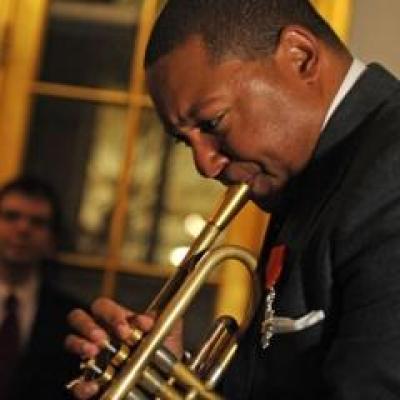
We're blues people. And blues never lets tragedy have the last word.
I think that virtuosity is the first sign of morality in a musician. It means you're serious enough to practice.
We always hear about the rights of democracy, but the major responsibility of it is participation.
When I did the Abyssinian mass, I went through the whole history of the church music and the gospel music, even with the Anglo American hymns, the Afro American hymns, the spirituals and how it developed, up to Thomas Dorsey and the Dixie Hummingbirds, going through the history of the music, jazz musicians.
I dress up a certain way because I respect the music.
And that's the soulful thing about playing: you offer something to somebody. You don't know if they'll like it, but you offer it.
The best way to be, is to do.
When it comes to songs and music, yeah, people love to sing and dance and play music and tunes, and that stream of consciousness that exists in music, nobody knows where that comes from.
How great musicians demonstrate a mutual respect and trust on the bandstand can alter your outlook on the world and enrich every aspect of your life, understanding what it means to be a global citizen in the most modern sense.
Jazz music celebrates life! Human life; the range of it, the absurdity of it, the ignorance of it, the greatness of it, the intelligence of it, the sexuality of it, the profundity of it. And it deals with it. In all of its... It deals with it!
Everything about the swing is about some guideline and some grid and the elegant way that you negotiate your way through that grid.
The blues is always there. It's going to be hard out here, but it's all right. It's all right, and that's what the blues teaches you. You got to roll with the punches and find your equilibrium.
Don't wish for someone else to do later what you can do now.
Whenever you face a man who's playing your instrument, there's a competition.
Jazz comes from our way of life, and because it's our national art form, it helps us to understand who we are.
But you listen to Coltrane and that's something human, something that's about elevation. It's like making love to a woman. It's about something of value, it's not just loud. It doesn't have that violent connotation to it. I wanted to be a jazz musician so bad, but I really couldn't. There was no way I could figure out to learn how to play.
Thank the good Lord for a job.
No particular music makes me feel nostalgic. If it's great, it just keeps me in the present moment. That level of music is like a classic story, like the Iliad-something so perfect it can never be old.
We created the spirituals. We created so much great music, jazz chief amongst our innovations, teaching us how to prize ourselves and how to speak to one another, that our kids don't know that achievement, there's no way in the world that could be good for us.
Many of our greatest musicians abandoned all of their aesthetic objectives to try to become pertinent. And, at the end of the day, they never became pop stars. I counter stated that very strongly, and I continue to do that.
We need more math classes, we need more science. It's the art of math and the art of science that creates all the innovation, and we have a tradition of great arts, great music.
Even in these times, there are still neighbors that will turn their backs on neighbors.
Sustained intensity equals ecstacy.
The reason why the music [jazz] is important is because it's an art form-an ancient art form-that takes in the mythology of our people.
Only a few act - the rest of us reap the benefits of their risk.
Young kids are always singing and painting. When you get to that second and third grade level, you're supposed to put all that aside.
Jazz music is America's past and its potential, summed up and sanctified and accessible to anybody who learns to listen to, feel, and understand it. The music can connect us to our earlier selves and to our better selves-to-come. It can remind us of where we fit on the time line of human achievement, an ultimate value of art.
The main three components are the blues, improvisation - which is some kind of element that people are trying to make it up - and swing, which means even though they're making up music, they're trying to make it up together. It feels great, like you're having a great conversation with somebody.
Everything comes out in blues music: joy , pain , struggle . Blues is affirmation with absolute elegance.
The soul gives us resilience - an essential quality since we constantly have to rebound from hardship.
This music heals people because music is vibration, and the proper vibration heals.
Music is always for the listener, but the first listener is always the musician
Louis Armstrong is jazz. He represents what the music is all about.
I have friends who will critique me much harder than any review.
The bandstand is a sacred place.
Humility is the doorway 2 truth & clarity of objectives... it's the doorway 2 learning.
It's harder to build than destroy. To build is to engage and change. In jazz, we call progressing harmonies changes. Changes are like obstacles on a speed course. They demand your attention and require you to be present. They are coming...they are here..... and then they are gone. It's how life comes. Each moment is a procession from the future into the past and the sweet spot is always the present. Live in that sweet spot. Be present.
Maybe the preoccupation with technological progress has overshadowed our concern with human progress.
What is deeper than respect and love? That’s what we felt: veneration.
The majority of the high schools and the public schools in N.Y.C. don't even have band programs. Hip-hop in a lot of ways is an outgrowth of a lack of instruments and a desire to play music, so we can't really fault the kids for that.
If you're not making mistakes, you're not trying.
My thing is, once you start to put a backbeat on your music or something that has a machine in it, you have popularity, but you lose the flexibility. And you lose a richness.
As long as there is democracy, there will be people wanting to play jazz because nothing else will ever so perfectly capture the democratic process in sound. Jazz means working things out musically with other people. You have to listen to other musicians and play with them even if you don't agree with what they're playing. It teaches you the very opposite of racism and anti-Semitism. It teaches you that the world is big enough to accommodate us all.
There's the tradition in jazz of having the “Battle of the Bands” and you do not want to get your head cut when you're playing.
For Black people, we're one of the only groups of people that for some reason to express love of yourself, in some ways, is misconstrued as a dislike for someone else.
Many a revolution started with the actions of a few. Only 56 men signed the Declaration of Independence. A few hanging together can lead a nation to change.
We all teach from that same frame of reference. We're like neighborhood - the people who have had the opportunity through this music to gain a platform and spread the message of this music, which is basically love in a form of communication that's honest and truthful.
Trumpet players are just belligerant, and cocky, and you know, just hard-headed.
My mother always took my brothers and me to music lessons. There were six children. Our parents attended our concerts and encouraged us to study and enjoy many different types of music.
Walt Whitman's "Leaves of Grass" is still in print. They're debating right now over Mark Twain. He's still available. Winslow Homer can still be seen. Our arts are - they're there. We got to go get them and understand that this is an important legacy for our country.
When did we begin to lose faith in our ability to effect change?
There really have only ever been a few people in each generation who step out, are willing to put themselves on the line, and risk everything for their beliefs.
I feel that for years of teaching in the country and reading criticism in books, I feel like the things most needed in our culture are the understanding of the meanings of our music. We haven't done that good of job teaching our kids what our music means or how we developed our taste in music that reminds us and teaches us who we are.
When I was 12, I began listening to John Coltrane and I developed a love for jazz, which I still have more and more each year.
You need a team. You need people to push you. You need opponents.
Because the blues is the basis of most American music in the 20th century. It's a 12-bar form that's played by jazz, bluegrass and country musicians. It has a rhythmic vocabulary that's been used by rock n' roll. It's related to spirituals, and even the American fiddle tradition.
In the Jazz at Lincoln Center Orchestra we play such a diversity of music, with 10 arrangers in the band, we don't really worry about whether it's contemporary or not.
Benny Goodman's band was integrated before baseball. Even before it was physically integrated, music was integrated. Everyone listened to Armstrong and Ellington. The 20s was called the Jazz Age. It's part of being American.
If you didn't have the amalgam of Blacks and African-type sensibility and European sensibility, you wouldn't have jazz. Even in the negative and in the positive ways - if there was no slavery and the abolition of slavery, there would be no jazz.
I have absolutely no idea what my generation did to enrich our democracy. We dropped the ball. We entered a period of complacency and closed our eyes to the public corruption of our democracy.
Instead of imposing your will on every situation...focus on including everyone else, and just that little adjustment of attitude gives you the space to understand where and who you are.
The real power of Jazz is that a group of people can come together and create improvised art and negotiate their agendas... and that negotiation is the art
Those who play for applause....Tha t’s all they get.
Flexibility is an essential part of Jazz. It's what gives Jazz music the ability to combine with all other types of music and not lose its identity.
If you want to be different, do something different.
We don't have the leadership or the understanding of the value of this, and when your political systems and your economic systems start to fail, it's only a cultural understanding that allows you to reconstruct them and to get back to who you are. For some reason, it hasn't dawned on us yet.
I worry more about the marketing that's taken hold since the 70s. The Jazz era, the Swing era, those were huge. Entire decades were named for music. In the 1940s - after World War II - changes in taxation, ballrooms closing, people moving to the suburbs, and the onset of target marketing and the confusion of commerce with art caused some things to happen as a result that have taken us away from jazz and what jazz offers us.
Everything comes out in blues music: joy, pain, struggle. Blues is affirmation with absolute elegance. It's about a man and a woman. So the pain and the struggle in the blues is that universal pain that comes from having your heart broken. Most blues songs are not about social statements.
The only justification for looking down on anyone is that you're going to stop and pick them up.
People have taken time out of their day and spent their money to come sit down at a concert. And it's jazz music-it's not easy for them to get to it. I don't want them ever to feel that I'm taking their presence lightly.
The first jazz musician was a trumpeter, Buddy Bolden, and the last will be a trumpeter, the archangel Gabriel.
Who creates a thing is not as important as what the thing is. Who created baseball? Who created basketball? Who created the space program? Who created - we could go on and on. We could argue about who created something. We all are participants in it.
I always like to play very contemporary concepts of swing right next to New Orleans music because it highlights continuum.
Jazz is not just 'Well, man, this is what I feel like playing.' It's a very structured thing that comes down from a tradition and requires a lot of thought and study.
The arts shows that you're civilized, and it makes life sweet. So you can exist and you can buy more things and you can be more - we're dealing with a form of commercialism that obscures a prior relationship to quality, and it's a national problem.
New Orleans had a great tradition of celebration. Opera, military marching bands, folk music, the blues, different types of church music, ragtime, echoes of traditional African drumming, and all of the dance styles that went with this music could be heard and seen throughout the city. When all of these kinds of music blended into one, jazz was born.
If you looked around, you'd be glad you couldn't see.
The arts speak across epochs. If you think that people started to build a cathedral in 1315 and the people worked on that cathedral, it wasn't going to be finished until 1585. So they were thinking 200 years from now. Maybe by the time I die, this wall might be put up.
I believed in studying just because I knew education was a privilege. It was the discipline of study, to get into the habit of doing something that you don't want to do.
The heart of a music is its rhythm. The heart of rhythm section music is the rhythm.
Jazz is not the kind of music you are going to learn to play in three or four years or that you can just get because you have some talent for music.
It's really not a stretch. The checks and balances are the same. The drums are the executive branch. The jazz orchestra is the legislative branch. Logic and reason are like jazz solos. The bass player is the judicial branch. One our greatest ever is Milt Hinton, and his nickname is "The Judge."
We learn a language through its song, and even if you don't have music you have the song of people you love's voice, and you'll notice that song in their voice.
The musicians, Duke Ellington, his thing was not about separating himself from the rest of America. Louis Armstrong - go to the forefathers of our music - Jelly Roll Morton - they're not preaching a separatist agenda. They're not taking their music and saying, "This is for me."
The nerves are a problem on trumpet, because when you mess up everyone can hear it. Just remember most people are too polite to say anything about it. That should calm your nerves.
Art is a luxury. It's not necessary for you to - you can work your job and you can make some money and never know who Walt Whitman was, and never read a poem.
Music is the art of all the invisible things that are real. Art, emotion, spiritual essence, consciousness - these things are hard to prove. Music helps you to focus on your sound. We understand that for very young kids.
Milk in a mother's breast-that's cool. Milk in a mouth-that's cool too. But milk in my trumpet? Not so cool. I have to play that thing.
Love is the spiritual essence of what we do. Technique is the manifestation of the preparation and investment as a result of the love.
Certain music, jazz in particular, has the ability to make you a better citizen of the world. It helps you expand your world view and gives you more confidence in your cultural achievements. Improvisational jazz teaches you about yourself while the swing in jazz teaches you how to work with others
You can reach a situation where things of intelligence and refinement and culture can be considered elite, and things that are crass and ignorant can be considered to be real and of the people. And when you begin to have the mass of populus striving for something that's not worth striving for, then tremendous amounts of energy go into...the maintenance of that which is worthless.
Don't settle for style. Succeed in substance.
Through first-class education, a generation marches down the long uncertain road of the future with confidence.
What takes its place is very dry education. And the tools that actually can teach you - singing and playing, learning how to participate with other people, spiritual richness - are replaced with a big emphasis on how to memorize things. That's such an incomplete education. Survival of the fittest used to mean being bigger and stronger.
This rebuilding of New Orleans gives us the perfect opportunity to see if we're ready to extend the legacy of Dr. King.
New Orleans - the real New Orleans - is the soul of the country.
Let the critics criticize and let the doers do.
Ethics are more important than laws. Which means that the exact note is less important than the feeling of the note.
A beat is a moment in the life a groove.
Having heard Clifford Brown play all those fast runs, I used to really practice Clarke trumpet exercises all day long so that I could play fast. That's all I wanted to do. I was like a child with a toy.
You don't try to duplicate certain things that other cats do, because you could never do it as well as they do. Nobody can get on that tenor saxophone and play like Trane, because he's the only one who can spell out chords and sound good when he does it.
What, other than injustice, could be the reason that the displaced citizens of New Orleans cannot be accommodated by the richest nation in the world?
When you study our greatest artists, you will find that they give us a key to understand how to deal with each other, and that our bloodlines are intertwined. It's not hyphenated America. That there is an America, and it is expressed in those arts. It gives us a key to figure out how to negotiate with each other, and it tells us actually who we are.
Many heroic things happened during slavery. And remember that there was a national movement away from it even at the time. The era of Reconstruction and then the subsequent dismantling of Reconstruction sent us in a tailspin. Then we had the Civil Rights movement. Now we have our first non-white president. We have a pattern of moving apart and then coming back together throughout the history of this country. Each time, we come closer.
Don't bullshit' just play.
The black hole in democracy is integrity. The great unspoken is integrity. When integrity is not first and foremost, it's quite palpable but not visible. It's always there. Jazz highlights it because musicians and jazz always represented a high level of integrity.
Jazz is democracy in music.
I believe in professionalism, but playing is not like a job. You have to be grateful to have the opportunity to play.
And my identity...I never really wondered about it because, unfortunately, I sounded like myself. People be saying I sound like Miles or Clifford Brown.
I grew up in the South, in New Orleans, where guys torture you all the time. So I didn't really grow up on the self-esteem campaign. When you were lousy at something, they told you you were lousy, and they told you how to fix it.
I try to put a lot of our music in my music - by that I mean of American music.
I play piano and drums very poorly and French horn and tuba all equally as bad.
In Jazz, improvisation isn't a matter of just making any ol' thing up. Jazz, like any language, has its own grammer and vocabulary. There's no right or wrong, just some choices that are better than others.
If you are serious about American culture and you are serious about Afro-American culture, you are in a lot of pain. You are not - you are not smiling about it.
When I came to New York, to Brooklyn, I met Alvin Ailey and Stanley Crouch and August Wilson. They were always putting things in a philosophical context. All the great jazz musicians did, too. There was always a sub-context to what they were saying about music even though they would be very down home and earthy. So I started to develop, in addition to my power and ability to simply hear, a way to place myself in a time.
Swing is extreme coordination. It's a maintaining balance, equilibrium. It's about executing very difficult rhythms with a panache and a feeling in the context of very strict time. So, everything about the swing is about some guideline and some grid and the elegant way that you negotiate your way through that grid.
I think that when the education system started to be dismantled during the first Great Depression in the 1930s, we didn't recover from that.
The blues. It runs through all American music. Somebody bending the note. The other is the two-beat groove. It's in New Orleans music, it's in jazz, it's in country music, it's in gospel.
Blues is like the roux in a gumbo. People ask me if jazz always has the blues in it. I say, if it sounds good it does.
My older brother and myself always played together in bands, but we never knew we would be professional musicians.
Jazz music is the power of now. There is no script. It's conversation. The emotion is given to you by musicians as they make split-second decisions to fulfill what they feel the moment requires.
Through improvisation, jazz teaches you about yourself. And through swing, it teaches you that other people are individuals too. It teaches you how to coordinate with them.
Jazz music is the power of now.
I remember when I wrote a piece, "Blood on the Fields," it was a while ago, it was about slavery and about two characters, and I studied so much of music, I would always go back to the original documents, and as much as I can get original chants and slave chants and different type of beats and rhythms and ring shout.
I didn't want to get that ring around my lips from practicing the trumpet, because I thought the girls wouldn't like me. So I never practiced.