still hope leads men to venture; and no one ever yet put himself in peril without the inward conviction that he would succeed in his design.
It is the habit of mankind to entrust to careless hope what they long for, and to use sovereign reason to thrust aside what they do not desire
For men naturally despise those who court them, but respect those who do not give way to them.
When tremendous dangers are involved, no one can be blamed for looking to his own interest.
Three of the gravest failings, want of sense, of courage, or of vigilance.
For so remarkably perverse is the nature of man that he despises whoever courts him, and admires whoever will not bend before him.
Self-control is the chief element in self-respect, and respect of self, in turn, is the chief element in courage.
The strong do what they have to do and the weak accept what they have to accept.
The meaning of words had no longer the same relation to things... Reckless daring was held to be loyal courage; prudent delay was the excuse of a coward; moderation was the disguise of unmanly weakness; to know everything was to do nothing. Frantic energy was the true quality of man.
speculation is carried on in safety, but, when it comes to action, fear causes failure.
By day certainly the combatants have a clearer notion, though even then by no means of all that takes place, no one knowing much of anything that does not does not go on in his own immediate neighborhood; but in a night engagement ( and this was the only one that occurred between great armies during the war) how could anyone know anything for certain?
It is men who make a city, not walls or ships.
We secure our friends not by accepting favours but by doing them.
For they had learned that true safety was to be found in long previous training, and not in eloquent exhortations uttered when they were going into action.
With reference to the narrative of events, far from permitting myself to derive it from the first source that came to hand, I did not even trust my own impressions, but it rests partly on what I saw myself, partly on what others saw for me, the accuracy of the report always being tried by the most severe and detailed tests possible. My conclusions have cost me some labour from the want of coincidence between accounts of the same occurrences by different eye-witnesses, arising sometimes from imperfect memory, sometimes from undue partiality for one side or the other.
There is no need to suppose that human beings differ very much one from another; but it is true that the ones who come out on top are the ones who have been trained in the hardest school.
The secret of happiness is freedom and the secret of freedom is courage.
We must not disguise from ourselves that we go to found a city among strangers and enemies, and he who undertakes such an enterprise should be prepared to become master of the country the first day he lands, or failing in this find everything hostile to him.
we know that there can never be any solid friendship between individuals, or union between communities that is worth the name, unless the parties be persuaded of each others honesty
A private man, however successful in his own dealing, if his country perish is involved in her destruction; but if he be an unprosperous citizen of a prosperous city, he is much more likely to recover. Seeing, then, that States can bear the misfortunes of individuals, but individuals cannot bear the misfortunes of States, let us all stand by our country.
War is a matter not so much of arms as of money.
In peace and prosperity states and individuals have better sentiments, because they do not find themselves suddenly confronted with imperious necessities; but war takes away the easy supply of daily wants and so proves a rough master that brings most men's characters to a level with their fortunes
Love of power, operating through greed and through personal ambition, was the cause of all these evils.
And where the rewards for merit are greatest, there are found the best citizens.
For we both alike know that into the discussion of human affairs the question of justice enters only where the pressure of necessity is equal, and that the powerful exact what they can, and the weak grant what they must.
It is from the greatest dangers that the greatest glory is to be won.
Indeed men too often take upon themselves in the prosecution of their revenge to set the example of doing away with those general laws to which all can look for salvation in adversity, instead of allowing them to subsist against the day of danger when their aid may be required
I dread our own mistakes more than the enemy's intentions.
We Greeks believe that a man who takes no part in public affairs is not merely lazy, but good for nothing
I am not blaming those who are resolved to rule, only those who show an even greater readiness to submit.
The Thracian people, like the bloodiest of the barbarians, being ever most murderous when it has nothing to fear.
So little trouble do men take in the search after truth; so readily do they accept whatever comes first to hand.
If you give way, you will instantly have to meet some greater demand, as having been frightened into obedience in the first instance; while a firm refusal will make them clearly understand that they must treat you more as equals.
An avowal of poverty is no disgrace to any man; to make no effort to escape it is indeed disgraceful.
If it had not been for the pernicious power of envy, men would not so have exalted vengeance above innocence and profit above justice... in these acts of revenge on others, men take it upon themselves to begin the process of repealing those general laws of humanity which are there to give a hope of salvation to all who are in distress.
I could have wished that the reputations of many brave men were not to be imperilled in the mouth of a single individual, to stand or fall according as he spoke well or ill. For it is hard to speak properly upon a subject where it is even difficult to convince your hearers that you are speaking the truth.
Wars spring from unseen and generally insignificant causes, the first outbreak being often but an explosion of anger.
Mankind are tolerant of the praises of others as long as each hearer thinks that he can do as well or nearly as well himself, but, when the speaker rises above him, jealousy is aroused and he begins to be incredulous.
There is, however, no advantage in reflections on the past further than may be of service to the present. For the future we must provide by maintaining what the present gives us and redoubling our efforts; it is hereditary to us to win virtue as the fruit of labour, and you must not change the habit, even though you should have a slight advantage in wealth and resources; for it is not right that what was won in want should be lost in plenty.
It must be thoroughly understood that war is a necessity, and that the more readily we accept it,the less will be the ardor of our opponents, and that out of the greatest dangers communities and individuals acquire the greatest glory.
When one is deprived of ones liberty, one is right in blaming not so much the man who puts the shackles on as the one who had the power to prevent him, but did not use it.
...knowing the secret of happiness to be freedom, and the secret of freedom a brave heart, not idly to stand aside from the enemy's onset.
And it is certain that those who do not yield to their equals, who keep terms with their superiors, and are moderate towards their inferiors, on the whole succeed best.
What made the war inevitable was the growth of Athenian power and the fear which this caused in Sparta.
Athens' biggest worry was the sheer recklessness of its own democratic government. A simple majority of the citizenry, urged on and incensed by clever demagogues, might capriciously send out military forces in unnecessary and exhausting adventures.
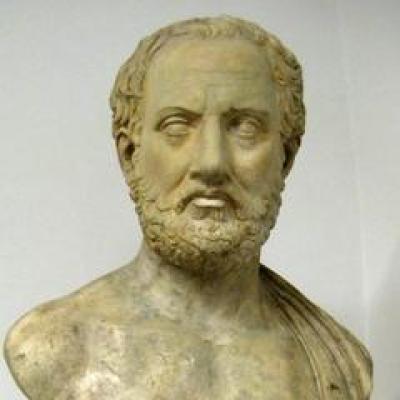
Thucydides, an Athenian, wrote the history of the war between the Peloponnesians and the Athenians, he began at the moment that it broke out, believing that it would be a great war, and more memorable than any that had preceded it.
Happiness depends on being free, and freedom depends on being courageous.
Those who really deserve praise are the people who, while human enough to enjoy power, nevertheless pay more attention to justice than they are compelled to do by their situation.
The growth of the power of Athens, and the alarm which this inspired in Sparta, made war inevitable.
Full of hopes beyond their power though not beyond their ambition.
We Greeks are lovers of the beautiful, yet simple in our tastes, and we cultivate the mind without loss of manliness.
He who graduates the harshest school, succeeds.
For if many ill-conceived plans have succeeded through the still greater lack of judgment of an opponent, many more, apparently well laid, have on the contrary ended in disgrace. The confidence with which we form our schemes is never completely justified in their execution; speculation is carried on in safety, but, when it comes to action, fear causes failure.
I think the two things most opposed to good counsel are haste and passion; haste usaully goes hand in hand with folly, passion with coarseness and narrowness of mind.
The strength of an Army lies in strict discipline and undeviating obedience to its officers.
The bravest are surely those who have the clearest vision of what is before them, glory and danger alike, and yet notwithstanding go out to meet it.
People get into the habit of entrusting the things they desire to wishful thinking, and subjecting things they don't desire to exhaustive thinking
The secret of freedom, courage.
Some legislators only wish to vengeance against a particular enemy. Others only look out for themselves. They devote very little time on the consideration of any public issue. They think that no harm will come from their neglect. They act as if it is always the business of somebody else to look after this or that. When this selfish notion is entertained by all, the commonwealth slowly begins to decay.
Men's indignation, it seems, is more exited by legal wrong than by violent wrong; the first looks like being cheated by an equal, the second like being compelled by a superior.
In a democracy, someone who fails to get elected to office can always console himself with the thought that there was something not quite fair about it.
But the prize for courage will surely be awarded most justly to those who best know the difference between hardship and pleasure and yet are never tempted to shrink from danger.
Peace is an armistice in a war that is continuously going on.
Men do not rest content with parrying the attacks of a superior, but often strike the first blow to prevent the attack being made.
... Athenians are addicted to innovation. They are daring beyond their judgment they toil on with little opportunity for enjoying, being ever engaged in getting, they were born into the world to take no rest themselves, and to give none to others.
Wealth to us is not mere material for vainglory but an opportunity for achievement; and poverty we think it no disgrace to acknowledge but a real degredation to make no effort to overcome.
It is a common mistake in going to war to begin at the wrong end, to act first, and wait for disasters to discuss the matter.
Hope, danger's comforter
He passes through life most securely who has least reason to reproach himself with complaisance toward his enemies.
To be an object of hatred and aversion to their contemporaries has been the usual fate of all those whose merit has raised them above the common level. The man who submits to the shafts of envy for the sake of noble objects pursues a judicious course for his own lasting fame. Hatred dies with its object, while merit soon breaks forth in full splendor, and his glory is handed down to posterity in never-dying strains.
On the whole, however, the conclusions I have drawn from the proofs quoted may, I believe, safely be relied on. Assuredly they will not be disturbed either by the lays of a poet displaying the exaggeration of his craft, or by the compositions of the chroniclers that are attractive at truth's expense; the subjects they treat of being out of the reach of evidence, and time having robbed most of them of historical value by enthroning them in the region of legend.
When a man finds a conclusion agreeable, he accepts it without argument, but when he finds it disagreeable, he will bring against it all the forces of logic and reason.
The absence of romance from my history will, I fear, detract somewhat from its interest; but if it be judged useful by those inquirers who desire an exact knowledge of the past as an aid to the interpretation of the future, which in the course of human things must resemble if it does not reflect it, I shall be content. In fine, I have written my work, not as an essay which is to win the applause of the moment, but as a possession for all time.
In general, the men of lower intelligence won out. Afraid of their own shortcomings and of the intelligence of their opponents, so that they would not lose out in reasoned argument or be taken by surprise by their quick-witted opponents, they boldly moved into action. Their enemies,on the contrary, contemptuous and confident in their ability to anticipate, thought there was no need to take by action what they could win by their brains.
The whole earth is the sepulchre of famous men.
For the love of gain would reconcile the weaker to the dominion of the stronger, and the possession of capital enabled the more powerful to reduce the smaller cities to subjection.
You should punish in the same manner those who commit crimes with those who accuse falsely.
Again, in our enterprises we present the singular spectacle of daring and deliberation, each carried to its highest point, and both united in the same persons; although usually decision is the fruit of ignorance, hesitation of reflection. But the palm of courage will surely be adjudged most justly to those, who best know the difference between hardship and pleasure and yet are never tempted to shrink from danger. In generosity we are equally singular, acquiring our friends by conferring, not by receiving, favours.
Right, as the world goes, is only in question between equals in power, while the strong do what they can and the weak suffer what they must.
Mankind apparently find it easier to drive away adversity than to retain prosperity.
The sufferings that fate inflicts on us should be borne with patience, what enemies inflict with manly courage.
It is useless to attack men who could not be controlled even if conquered, while failure would leave us in an even worse position.
They whose minds are least sensitive to calamity, and whose hands are most quick to meet it, are the greatest men and the greatest communities.
I have often before now been convinced that a democracy is incapable of empire.
Most people, in fact, will not take the trouble in finding out the truth, but are much more inclined to accept the first story they hear.
The Peloponnesian War turns out to be no dry chronicle of abstract cause and effect. No, it is above all an intense, riveting, and timeless story of strong and weak men, of heroes and scoundrels and innocents too, all caught in the fateful circumstances of rebellion, plague, and war that always strip away the veneer of culture and show us for what we really are.
Remember that this greatness was won by men with courage, with knowledge of their duty, and with a sense of honor in action.
Contempt for an assailant is best shown by bravery in action.
Ignorance is bold and knowledge reserved.
Those who have experienced good and bad luck many times have every reason to be skeptical of successes
History is Philosophy teaching by example.
The peoples of the Mediterranean began to emerge from barbarism when they learned to cultivate the olive and the vine.
Stories happen to those who tell them.
Abstinence from all injustice to other first-rate powers is a greater tower of strength than anything that can be gained by the sacrifice of permanent tranquillity for an apparent temporary advantage.
For men can endure to hear others praised only so long as they can severally persuade themselves of their own ability to equal the actions recounted: when this point is passed, envy comes in and with it incredulity.
It is a general rule of human nature that people despise those who treat them well, and look up to those who make no concessions.
Of the gods we believe, and of men we know, that by a necessary law of their nature they rule wherever they can.
As for democracy, the men of sense among us knew what it was, and I perhaps as well as any, as I have more cause to complain of it; but there is nothing new to be said of a patent absurdity-meanwhile we did not think it safe to alter it under the pressure of your hostility.
Hatred also is short lived; but that which makes the splendor of the present and the glory of the future remains forever unforgotten here we bless your simplicity but do not envy your folly.
You can now, if you choose, employ your present success to advantage, so as to keep what you have got and gain honour and reputation besides, and you can avoid the mistake of those who meet with an extraordinary piece of good fortune, and are led on by hope to grasp continually at something further, through having already succeeded without expecting it.
Human nature is the one constant through human history. It is always there.
It is frequently a misfortune to have very brilliant men in charge of affairs. They expect too much of ordinary men.
Few things are brought to a successful issue by impetuous desire, but most by calm and prudent forethought.
They are surely to be esteemed the bravest spirits who, having the clearest sense of both the pains and pleasures of life, do not on that account shrink from danger.
concessions to adversaries only end in self reproach, and the more strictly they are avoided the greater will be the chance of security.
In practice we always base our preparations against an enemy on the assumption that his plans are good; indeed, it is right to rest our hopes not on a belief in his blunders, but on the soundness of our provisions. Nor ought we to believe that there is much difference between man and man, but to think that the superiority lies with him who is reared in the severest school.
When will there be justice in Athens? There will be justice in Athens when those who are not injured are as outraged as those who are.
Amassing of wealth is an opportunity for good deeds, not hubris
The cause of all these evils was the lust for power arising from greed and ambition; and from these passions proceeded the violence of parties once engaged in contention.
Be convinced that to be happy means to be free and that to be free means to be brave. Therefore do not take lightly the perils of war.
One's sense of honor is the only thing that does not grow old, and the last pleasure, when one is worn out with age, is not, as the poet said, making money, but having the respect of one's fellow men.
Indeed it is generally the case that men are readier to call rogues clever than simpletons honest, and are ashamed of being the second as they are proud of being the first.
Hope is an expensive commodity. It makes better sense to be prepared.
The wide difference between the two characters, the slowness and want of energy of the Spartans as contrasted with the dash and enterprise of their opponents, proved of the greatest service, especially to a maritime empire like Athens. Indeed this was shown by the Syracusans, who were most like the Athenians in character, and also most successful in combating them.
Don't confuse meaning with truth.
I have written my work, not as an essay which is to win the applause of the moment, but as a possession for all time
Now the only sure basis of an alliance is for each party to be equally afraid of the other
Knowledge without understanding is useless.
The superior gratification derived from the use and contemplation of costly and supposedly beautiful products is, commonly, in great measure a gratification of our sense of costliness masquerading under the name of beauty.
War is an evil thing; but to submit to the dictation of other states is worse.... Freedom, if we hold fast to it, will ultimately restore our losses, but submission will mean permanent loss of all that we value.... To you who call yourselves men of peace, I say: You are not safe unless you have men of action on your side.
You shouldn't feel sorry for the lifestyle you haven't tasted, but for the one you are about to lose
In a word I claim that our city as a whole is an education to Greece.
We must remember that one man is much the same as another, and that he is best who is trained in the severest school.
Of all manifestations of power, restraint impresses men most.
Boasting and bravado may exist in the breast even of the coward, if he is successful through a mere lucky hit; but a just contempt of an enemy can alone arise in those who feel that they are superior to their opponent by the prudence of their measures.