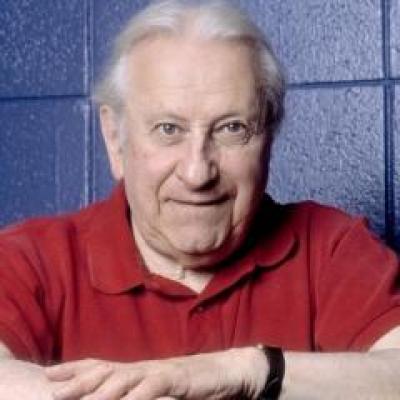
I call myself a radical conservative. What's that? Well, let's analyze it. Go to the dictionary. Radical: One who gets to the roots of things. And I'm a conservative because I want to conserve the green of the grass, the potability of drinking water, the first amendment of the Constitution and whatever sanity we have left.
We are living in the United States of Alzheimer's. A whole country has lost its memory. When it can't remember yesterday, a country forgets what it once wanted to be.
When I put the plate down, you don't hear a sound. When I pick up a glass, I want it to be just right. When someone says, "How come you're just a waitress?" I say, "Don't you think you deserve being served by me?"
I cannot even picture myself retiring. What would I do? I'll always be doing something, asking somebody questions, even if there weren't a book.
'Curiosity never killed this cat’ — that’s what I’d like as my epitaph.
Cannot Hannah Arendt's 'banality of evil' be subject to transposition: the evil of banality?
I'm not an optimist. I'm hopeful.
There are nascent stirrings in the neighborhood and in the field, articulated by non-celebrated people who bespeak the dreams of their fellows. It may be catching. Unfortunately, it is not covered on the six o'clock news.
I want a language that speaks the truth.
What I bring to the interview is respect. The person recognizes that you respect them because you're listening. Because you're listening, they feel good about talking to you. When someone tells me a thing that happened, what do I feel inside? I want to get the story out. It's for the person who reads it to have the feeling . . . In most cases the person I encounter is not a celebrity; rather the ordinary person. "Ordinary" is a word I loathe. It has a patronizing air. I have come across ordinary people who have done extraordinary things. (p. 176)
I'm celebrated for celebrating the uncelebrated.
When I was asked: "Will shame do it?" Meaning: Will welfare people be shamed into getting respectable work? And I said that shame plays the biggest role there is: The biggest shame is that there is so much abundance around but that so many have so little and so few have so much. That's the shame.
Work is born in us. We take to it kindly or unkindly. The terms may be easy or harsh, but the contract is binding.
At a time when pimpery, lick-spittlery, and picking the public's pocket are the order of the day - indeed, officially proclaimed as virtue - the poet must play the madcap to keep his balance. And ours.
We use the word 'hope' perhaps more often than any other word in the vocabulary: 'I hope it's a nice day.' 'Hopefully, you're doing well.' 'So how are things going along? Pretty good. Going to be good tomorrow? Hope so.'
Reading a book should not be a passive exercise, but rather a raucous conversation.
One night a guy hit his head on a welding gun. He went to his knees. He was bleeding like a pig, blood was oozing out. So I stopped the line for a second and ran over to help him. The foreman turned the line on again, he almost stepped on the guy. That's the first thing they always do. They didn't even call an ambulance. The guy walked to the medic department -- that's about half a mile -- he had about five stitches put in his head. The foreman didn't say anything. He just turned the line on. You're nothing to any of them.
That's what we're missing. We're missing argument. We're missing debate. We're missing colloquy. We're missing all sorts of things. Instead, we're accepting.
Tom Paine was a great American visionary. His book, Common Sense, sold a couple of hundred thousand copies in a population of four or five million. That means it was a best seller for years. People were thoughtful then. Hope is one thing. But you need to have hope with thought.
I hope that memory is valued - that we do not lose memory.
More and more we are into communications; and less and less into communication.
It is still the arena of those who dream of the City of Man and those who envision a City of Things. The battle appears to be forever joined. The armies, ignorant and enlightened, clash by day as well as night. Chicago is America's dream, writ large. And flamboyantly.
I'd want the human voice expressing grievances, or delight, or whatever it might be. But something real
An agnostic is a cowardly atheist.
I'm not up on the Internet, but I hear that is a democratic possibility. People can connect with each other. I think people are ready for something, but there is no leadership to offer it to them. People are ready to say, 'Yes, we are part of a world.
I presumably lost $150,000 in the depression of 1937—on my one stock investment—because I did everything Lehman Brothers told me. I said, well, this is a fool’s procedure . . . buying stock in other people’s businesses.
To survive the day is triumph enough for the walking wounded among the great many of us.
One of the definitive works on gay life. Through this collective testimony we may come to understand what it is to be 'the other'; in short, the other part of ourselves.
If solace is any sort of succor to someone, that is sufficient. I believe in the faith of people, whatever faith they may have.
You can work next to a guy for months without even knowing his name.
If there is knowledge, it lies in the fusion of the book and the street.
Think of what's stored in an 80- or a 90-year-old mind. Just marvel at it. You've got to get out this information, this knowledge, because you've got something to pass on. There'll be nobody like you ever again. Make the most of every molecule you've got as long as you've got a second to go.
I find labels "liberal" and "conservative" of little meaning. Our language has become perverted along with the thoughts of many of us.
Hope never trickles down. It always springs up.
Don't be an examiner, be the interested inquirer.
I'm not a Luddite completely; I believe in refrigerators to cool my martinis, and washing machines because I hate to see women smacking their laundry against a rock. When I hear about hardware, I think of pots and pans, and when I hear about software, I think of sheets and towels.
A guy I interviewed for Hard Times says, "What do I remember about the Great Depression? That I was hungry, that's all." Elemental things.
When you become part of something, in some way you count. It could be a march; it could be a rally, even a brief one. You're part of something, and you suddenly realize you count. To count is very important.
You know, 'power corrupts, and absolute power corrupts absolutely'? It's the same with powerlessness. Absolute powerlessness corrupts absolutely. Einstein said everything had changed since the atom was split, except the way we think. We have to think anew.
We're born eventually to die, of course. But what happens between the time we're born and we die? We're born to live. One is a realist if one hopes.
I want people to talk to one another no matter what their difference of opinion might be.
The answer is to say 'No!' to authority when authority is wrong.
I never drove a car. I'm hopeless that way. I press the wrong buttons on the tape recorder. But if the person I'm interviewing helps me out, that person feels needed. People need to feel needed.
All you need in life is truth and beauty and you can find both at the Public Library.
Religion obviously played a role in this book and the previous book, too.
I want, of course, peace, grace, and beauty. How do you do that? You work for it.
I'm called an oral historian, which is something of a joke. Oral history was here long before the pen, long before Gutenberg and the printing press. The difference is I have a tape recorder in my hand.
I said, "Suppose communists come out against cancer, do we have to automatically come out for cancer?'" I can't take back that I'm against the poll tax, that I'm against lynching, that I'm for peace.
I think it's realistic to have hope. One can be a perverse idealist and say the easiest thing: 'I despair. The world's no good.' That's a perverse idealist. It's practical to hope, because the hope is for us to survive as a human species. That's very realistic.
I am paraphrasing Einstein. I love to do that: nobody dares contradict me.
When it comes to the news, the corporate view is `objective,' all else is propaganda.
Once you wake up the human animal, you can't put it back to sleep again.
The history of those who shed those other tears, the history of those anonymous millions, is what Terkel wants readers and listeners to come away with. What's it like to be that goofy little soldier, scared stiff, with his bayonet aimed at Christ? What's it like to have been a woman in a defense-plant job during World War II? What's it like to be a kid at the front lines? It's all funny and tragic at the same time.
I guess I was seeking some balance in the wildlife of the city as Rachel Carson sought it in nature. In unbalanced times, balance is as difficult to come by as Parsifal's Grail.
On the evening bus, the tense, pinched faces of young file clerks and elderly secretaries tell us more than we care to know. On the expressways, middle management men pose without grace behind their wheels as they flee city and job.
My doctors were of one mind: unless something was immediately done, I had maybe six months to live. A quintuple bypass was suggested. Quintuple! I was impressed, though somewhat disturbed because I was in the middle of work on a new book.
Last year I picked up the New York Times and there was a story about a kid from Dartmouth who was bragging that he never left his room, and made dates and ordered pizza with his computer. The piece de resistance of this story was that he had two roommates, and he was proud of the fact that he only talked to them by computer.
My epitaph? My epitaph will be, 'Curiosity did not kill this cat'.
Most of us, like the assembly line worker, have jobs that are too small for our spirit. Jobs are not big enough for people.
Heroes are not giant statues framed against a red sky. They are people who say: This is my community, and it is my responsibility to make it better. Interweave all these communities and you really have an America that is back on its feet again. I really think we are gonna have to reassess what constitutes a 'hero'.
But once you become active in something, something happens to you. You get excited and suddenly you realize you count.
The trouble with censorship is that once it starts it is hard to stop. Just about every book contains something that someone objects to.
We hear the term independent contractors in Iraq. Independent contractors? Mercenaries!
I've always felt, in all my books, that there's a deep decency in the American people and a native intelligence - providing they have the facts, providing they have the information.
You happen to be talking to an agnostic. You know what an agnostic is? A cowardly atheist.
Work is a search for daily meaning as well as for daily bread.
I have a big mouth, and I never met a petition I didn't like, so of course in the McCarthy days I got in trouble.
Something was still there, that something that distinguishes an artist from a performer: the revealing of self. Here I be. Not forlong, but here I be. In sensing her mortality, we sensed our own.
People are hungry for stories. It's part of our very being. Storytelling is a form of history, of immortality too. It goes from one generation to another. -Studs Terkel
Having been blacklisted from working in television during the McCarthy era, I know the harm of government using private corporations to intrude into the lives of innocent Americans. When government uses the telephone companies to create massive databases of all our phone calls it has gone too far.
People are hungry for stories. It's part of our very being.
If we're to have a future in the 21st century, we'll want to be able to say, "Now what was the 20th century like in the United States of America, the most powerful of all countries of that century? What was it like to be an ordinary person?"
One day I visited a guy who had made a fortune as a broker. He was sitting in his office with his computer. I hire people from here and make deals from this room, he told me. Then he took me to the trading room. Nobody was talking to anybody else, the place was silent as a tomb, they were all sitting there watching their terminals - a great word, terminal. I tell you, it scares the crap out of me.
All the other books ask, 'What's it like?' What was World War II like for the young kid at Normandy, or what is work like for a woman having a job for the first time in her life? What's it like to be black or white?
Perhaps it is this specter that most haunts working men and women: the planned obsolescence of people that is of a piece with the planned obsolescence of the things they make. Or sell.
Dorothy Day said - and I'm sure that Kathy Kelly would say the same thing - 'I'm working toward a world in which it will be easier for people to behave decently.' Now, think about that: a world in which it will be easier for people to behave decently.
Unless there's a grassroots movement of some sort, with TV and the media in general in the hands of fewer and fewer people - the Murdochians, you know - all we hear is the one point of view. There has to be something communal.
No matter what the issues are, it has to be handled at the grassroots. When you take part in something, even though that movement may lose, the juices start flowing and you feel you count. You count. Well, that's pretty important.
For the next century, we've got to put together what we so carelessly tore apart with so little concern for those who were gonna follow us. ... You've got to sound off.
Chicago is not the most corrupt American city. It's the most theatrically corrupt.
Marvin Miller, I suspect, is the most effective union organizer since John L. Lewis.
Work is about a search for daily meaning as well as daily bread, for recognition as well as cash, for astonishment rather than torpor; in short, for a sort of life rather than a Monday through Friday sort of dying.
People are ready to say, 'Yes, we are ready for single-payer health insurance.' We are the only industrialized country in the world that does not have national health insurance. We are the richest in wealth and the poorest in health of all the industrial nations.
So how are things going along? Pretty good. Going to be good tomorrow? Hope so.
I was born in the year the Titanic sank. The Titanic went down, and I came up. That tells you a little about the fairness of life.
Most of us have jobs that are too small for our spirits.
I read somewhere that when a person takes part in community action, his health improves. Something happens to him or to her biologically. It's like a tonic.
The issue is jobs. You can't get away from it: jobs. Having a buck or two in your pocket and feeling like somebody.
With optimism, you look upon the sunny side of things. People say, 'Studs, you're an optimist.' I never said I was an optimist. I have hope because what's the alternative to hope? Despair? If you have despair, you might as well put your head in the oven.
I hope for peace and sanity - it's the same thing.
Nonetheless, do I have respect for people who believe in the hereafter? Of course I do. I might add, perhaps even a touch of envy too, because of the solace.
Never go to bed with someone whose problems are greater than yours.
I always love to quote Albert Einstein because nobody dares contradict him.
I want to praise activists through the years. I praise those of the past as well, to have them honored.
The people in Coming of Age were far less curmudgeonly than you would think. The greater percentage said that without the young we'd be lost. One woman, a former Southern belle, now 87, a philanthropist, says, "Well, these young, their history's been stolen from them. And what have we done to make them respect us?"
Taking life seriously requires taking death seriously.
In order for us, black and white, to disenthrall ourselves from the harshest slavemaster, racism, we must disinter our buried history.... We are all the Pilgrim, setting out on this journey.
How come you don't work fourteen hours a day? Your great-great-grandparents did. How come you only work the eight-hour day? Four guys got hanged fighting for the eight-hour day for you.
Smug respectability, like the poor, we've had with us always. Today, however, ... such obtuseness is an indulgence we can no longer afford. The computer, nuclear energy for better or worse, and sudden, simultaneous influences upon everyone's TV screen have raised the ante and the risk considerably.
Ordinary people are capable of doing extraordinary things, and that's what it's all about. They must count.
Ordinary' is a word I loathe. It has a patronizing air. I have come across ordinary people who have done extraordinary things.
I thought, if ever there were a time to write a book about hope, it's now.
I suppose if I have an epitaph it would be: "Curiosity Did Not Kill This Cat." I don't see retiring in the sense that we view it - I don't see how I could. Dying at the microphone or at the typewriter would not be bad.