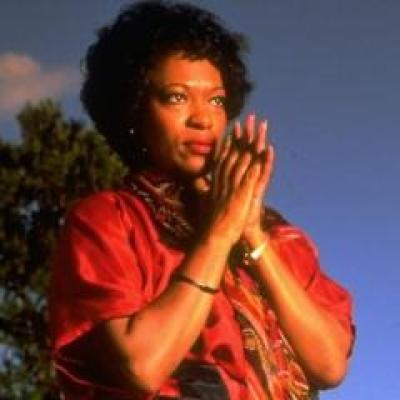
I thought, after the Pulitzer, at least nothing will surprise me quite that much in my life. And another one happened. It was quite amazing.
The sound of the mandolin is a very curious sound because it's cheerful and melancholy at the same time, and I think it comes from that shadow string, the double strings.
If we’re going to solve the problems of the world, we have to learn how to talk to one another. Poetry is the language at its essence. It’s the bones and the skeleton of the language. It teaches you, if nothing else, how to choose your words.
My best times are midnight to six actually. I'll leaf through my notebooks and if something catches my eye and I feel like I want to transfer it from the notebook to the page, I do, and then comes this very strange process which is difficult to describe in that I'll write until I get stuck or I can't go any further or I'm boring myself or whatever and then I might go to another poem.
I prefer to explore the most intimate moments, the smaller, crystallized details we all hinge our lives on.
I think children have talent and insight, but it gets beaten out of them.
Poetry is language at its most distilled and most powerful.
I'm never quite sure how the poem is going to resolve itself and that I'm always in some way surprised. I make a discovery in a poem as I write it.
People write me from all over the country, asking me, and sometimes even telling me, what they think a poet laureate should do. I found that immensely valuable.
If we really want to be full and generous in spirit, we have no choice but to trust at some level.
To me, a poem is almost like someone whispering to another person, or you hear the whispering in your head. I hope with my own poems that the reader feels a connection, soul to soul, that'll help us all feel a little less alone on the planet. And it does have the power to direct change. A writer can make the word 'dark' be something positive. You can relieve a word like 'hysterical' of its misogynistic implications. You can make the language your own. That's what poetry is about.
Without imagination we can go nowhere. And imagination is not restricted to the arts. Every scientist I have met who has been a success has had to imagine.
One definition of eternity is that we are not alone on this planet, that there are those who've gone before and those who will come, and that there is a community of spirits.
When I was young, I was older than I am today.
I loved to write when I was a child. I wrote, but I always thought it was something that you did as a child, then you put away childish things.
The joy of working at something to find out what it means to me is what I grew up with.
Don't be so fast, you're all you've got.
Being Poet Laureate made me realize I was capable of a larger voice. There is a more public utterance I can make as a poet.
Libraries are where it all begins.
I think reading Shakespeare's plays when I was young was extremely important. He had the ability to make utter strangers come alive.
I change jobs like drinking water ... And as I grow accustomed to the new flavor of a drink I regard as delicious, yes, vital, something fades, life balks. So I break camp; I shed skins.
Creative writing and literacy go hand and hand.
It's unfortunate that sometimes in schools, there's this need to have things quantified and graded.
I've always been intrigued by the way history works, the way we decide what is mentioned.
Poetry of all the forms of literature I think is the most suited for the digital age and for the shorter attention spans and all of that. It Twitters very easily, some lyric poems and it's very easy to zip a poem to someone, so that's one of the things I think is wonderful about poetry in the digital age.
If only the sun-drenched celebrities are being noticed and worshiped, then our children are going to have a tough time seeing the value in the shadows, where the thinkers, probers and scientists are keeping society together.
Being true to yourself really means being true to all the complexities of the human spirit.
Instead of trying to come up and pontificate on what literature is, you need to talk with children, to teachers, and make sure they get poetry in the curriculum early.
The First Book: Go ahead, it won't bite. Well... maybe a little. More a nip, like. A tingle. It's pleasurable, really. You see, it keeps on opening. You may fall in. Sure, it's hard to get started; remember learning to use knife and fork? Dig in: you'll never reach bottom. It's not like it's the end of the world -- just the world as you think you know it.
I was apprehensive. I feared every time I talked about poetry, it would be filtered through the lens of race, sex, and age.
If our children are unable to voice what they mean, no one will know how they feel. If they can’t imagine a different world, they are stumbling through a darkness made all the more sinister by its lack of reference points. For a young person growing up in America’s alienated neighborhoods, there can be no greater empowerment than to dare to speak from the heart — and then to discover that one is not alone in ones feelings.
Courage has nothing to do with our determination to be great. It has to do with what we decide in that moment when we are called upon to be more.
I think if you put something in a file that says "war poems" or "love poems" that you already restrict the way in which the poem might move.
My favorite poets may not be your bread and butter. I have more favorite poems than favorite poets.
I have a high guilt quotient. A poem can go through as many as 50 or 60 drafts. It can take from a day to two years - or longer.
I didn't know writers could be real live people, because I never knew any writers.
A good poem is like a bouillon cube. It's concentrated and it nourishes you when you need it.
I've always felt that the poems I've written which have historical context are hopefully not just simply plucking something out of history and saying great, let's write about that. In every case what has happened is that I've become fascinated or haunted by something and couldn't shake it.
It really wasn't until I was in college when I began to write more and more, and I realized I was scheduling my entire life around my writing
In working on a poem, I love to revise. Lots of younger poets don't enjoy this, but in the process of revision I discover things
Rap is only one end of a whole spectrum of verbal play and virtuosity. Rap is geared for aural pleasure.
As an African-American, as a woman I think that I've been sensitized to the way in which history privileges the white male and the way in which certain aspects of history, the things that we are taught in school, the things that are handed down never, never entered the picture though they might have been very important.
There are distinct duties of a poet laureate. I plan a reading series at the Library of Congress and advise the librarian. The rest is how I want to promote poetry
We tend to be so bombarded with information, and we move so quickly, that there's a tendency to treat everything on the surface level and process things quickly. This is antithetical to the kind of openness and perception you have to have to be receptive to poetry.poetry seems to exist in a parallel universe outside daily life in America.
I think that you certainly don't have to be aged and travel the world to write a poem.
Nothing is too small. Nothing is too, quote-unquote, ordinary or insignificant. Those are the things that make up the measure of our days, and they're the things that sustain us. And they're the things that certainly can become worthy of poetry.
What is ironic is that Allen Ginsberg's importance was in its twilight for so many years that it took his death to bring it to the front page. He electrified an entire world!
By making us stop for a moment, poetry gives us an opportunity to think about ourselves as human beings on this planet and what we mean to each other.
I always loved science. And in fact, I got a science award in high school. I mean, I loved science, but I think I loved literature more.
We should always do something that makes us feel like a child again. Keep learning, no matter what it is.
There are times in life when, instead of complaining, you do something about your complaints.
To write for PC reasons, because you think you ought to be dealing with this subject, is never going to yield anything that is really going to matter to anyone else. It has to matter to you.
I see a resurgence of interest in poetry. I am less optimistic about the prospects for the arts when it comes to federal funding.
From the time I began to read, as a child, I loved to feel their heft in my hand and the warm spot caused by their intimate weight in my lap; I loved the crisp whisper of a page turning, the musky odor of old paper and the sharp inky whiff of new pages. Leather bindings sent me into ecstasy. I even loved to gaze at a closed book and daydream about the possibilities inside.
The poetry that sustains me is when I feel that, for a minute, the clouds have parted and I've seen ecstasy or something
Sometimes a word is found so right it trembles at the slightest explanation.
My inspiration comes from everywhere, just walking down the street and I never know where it's going to come from, so I keep a notebook with me at all times and the only criteria for anything making it into that notebook is if it stops me in my tracks for even an instant, if it catches my eye or my ear and I just write it down.
It's the combination of the intimate and the public that I find so exciting about being poet laureate.
If you can't be free, be a mystery.
I loved to read, but I always thought that the dream was too far away. The person who had written the book was a god, it wasn't a person.
To practice your scales, so to speak, in order play the symphony, is what you have to do as a young poet.
Equality and self-determination should never be divided in the name of religious or ideological fervor.
I never think of my audience when I write a poem. I try to write out of whatever is haunting me; in order for a poem to feel authentic, I have to feel I'm treading on very dangerous ground, which can mean that the resulting revelations may prove hurtful to other people. The time for thinking about that kind of guilt or any collective sense of responsibility, however, occurs much later in the creative process, after the poem is finished.
If I begin writing a poem that means I'm intrigued in some way by whatever it's about and that if I'm not trying to find something new and pushing the envelope in the poem I can't expect my reader to be particularly excited about it either.
My father is a chemist, my mother was a homemaker. My parents instilled in us the feeling that learning was the most exciting thing that could happen to you, and it never ends.
In fact, sometimes traveling the world is a way of not writing a poem, but it's the quality of experience. It's being able to experience something and when you begin to write about it be able to apply the tools that you need for writing.
I carry a notebook with me everywhere. But that's only the first step.
It makes me furious to hear haters of all skin colors - especially Christian, Jewish, and Muslim fundamentalists - deride other people because of their different beliefs and lifestyles.
At the very beginning when I begin writing a poem I try not to think of the audience or anyone at all except for trying to get at the very center of what is driving that poem. In a way it's like analyzing myself.
If the poem is so moving that even if you have no experience in that particular setting be it 1920's Harlem let's say. You still are so moved that you can put yourself in that position. That means that the writer has managed to go beyond the personal and touch the humanity in all of us and it's really a blast to read it because I realize how that this does hold true for the truly great poems.
My childhood library was small enough not to be intimidating. And yet I felt the whole world was contained in those two rooms. I could walk any aisle and smell wisdom.
Under adversity, under oppression, the words begin to fail, the easy words begin to fail. In order to convey things accurately, the human being is almost forced to find the most precise words possible, which is a precondition for literature.
I was not interested in doing the plot of Oedipus in blackface. I did wonder, what would these people have been like if they hadn't been in that situation?... One could look at Oedipus, or at my character Augustus, as a cynical schemer who did everything because he was hungry for power. But that's just too easy. I'm more interested in how humans can embody conflicting goals and emotions.
I believe people may have a predisposition for artistic creativity. It doesn't mean they're going to make it.
When we are touched by something it's as if we're being brushed by an angel's wings.
Crassly put: When I write, I am trying not to bore myself and my readers.
The library is an arena of possibility, opening both a window into the soul and a door onto the world.
Everybody who's anybody longs to be a tree.
All of us have moments in our childhood where we come alive for the first time. And we go back to those moments and think, This is when I became myself.
Anyone can tell you that how you're raised as a child has a great deal to do with how you behave as an adult and whether you have complexes or whether you need to prove yourself or all that kind of stuff and yet the mother in a traditional family who has raised a child never makes it in the history books.
I wish someone had told me that my stories are really mine to tell. In other words, anything that I think is important or that has moved me has the ability to move somebody else.
For years, I had heard about the lack of interest in literature in the U.S. and I had complained about the lack of respect artists got here. In my heart, I failed to understand how people could fail to be moved by art.
I grew up in Ohio, where civil-rights accomplishments had already begun to accelerate before Martin Luther King appeared. In hindsight, we know that many people, black and white, were instrumental in changing the Jim Crow status quo on all levels.
You have to imagine it possible before you can see something. You can have the evidence right in front of you, but if you can't imagine something that has never existed before, it's impossible.
I try to show what it is about language and music that enthralls, because I think those are the two elements of poetry.
Going to the library was the one place we got to go without asking for permission. And they let us choose what we wanted to read. It was a feeling of having a book be mine entirely.
I was appointed Poet Laureate. It came totally out of the blue because most Poet Laureates had been considerably older than I. It was not something that I even had begun to dream about!
I write short stories, and I wrote a play.
What writing does is to reveal.
My first advice would be to read, read, read, which sounds interesting coming in a digital age, but it's so much easier to listen to a poem than it is to sit down and actually read it and to hear it in your head and that is something that every poet or aspiring poet needs to be able to do, I think to hear it in their head.
Listen how they say your name. If they can't say that right, there's no way they're going to know how to treat you proper, neither.
I keep the drafts of each poem in color-coded folders. I pick up the folders according to how I feel about that color that day.
I think that when a poem can move readers across generations and across its specific class or race then it becomes truly classic.
The American Dream is a phrase we'll have to wrestle with all of our lives. It means a lot of things to different people. I think we're redefining it now
Can it be that even as one grows to fit the space one lives in, one cannot grow until there's space to grow?
If they don't read, if they don't love reading; if they don't find themselves compulsively reading, I don't think they're really a writer
Have you ever heard a good joke? If you've ever heard someone just right, with the right pacing, then you're already on the way to poetry. It's about using words in very precise ways and using gesture.
Poetry connects you to yourself, to the self that doesn't know how to talk or negotiate.
For many years, I thought a poem was a whisper overheard, not an aria heard.
What's a word, a talisman, to hold against the world?
I was pirouette and flourish, I was filigree and flame. How could I count my blessings when I didn't know their names?