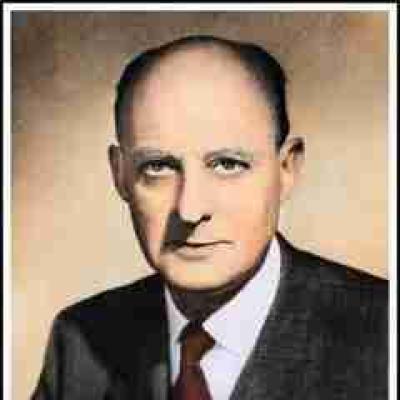
Nothing we do, however virtuous, can be accomplished alone; therefore, we are saved by love. No virtuous act is quite as virtuous from the standpoint of our friend or foe as it is from our own standpoint. Therefore we must be saved by the final form of love, which is forgiveness.
Ultimately evil is done not so much by evil people, but by good people who do not know themselves and who do not probe deeply.
All men who live with any degree of serenity live by some assurance of grace.
The will-to-live becomes the will-to-power.
Man is both strong and weak, both free and bound, both blind and far-seeing. He stands at the juncture of nature and spirit; and is involved in both freedom and necessity.
Nothing which is true or beautiful or good makes complete sense in any immediate context of history; therefore we must be saved by faith.
Humor is a prelude to faith and laughter is the beginning of prayer.
To be religious is not to feel, but to be.
It is significant that it is as difficult to get charity out of piety as to get reasonableness out of rationalism.
Toleration of people who differ in convictions and habits requires a residual awareness of the complexity of truth and the possibility of opposing view having some light on one or the other facet of a many-sided truth.
A church has the right to set its own standards within its community. I don't think it has a right to prohibit birth control or to enforce upon a secular society its conception of divorce and the indissolubility of the marriage tie.
The fence and the boundary line are the symbols of the spirit of justice. They set the limits upon each man's interest to prevent one from taking advantage of the other.
The individual or the group which organizes any society, however social its intentions or pretensions, arrogates an inordinate portion of social privilege to itself.
[There is] an increasing tendency among modern men to imagine themselves ethical because they have delegated their vices to larger and larger groups.
Nationalism: One of the effective ways in which the modern man escapes life's ethical problems.
We take, and must continue to take, morally hazardous actions to preserve our civilization. We must exercise our power. But we ought neither to believe that a nation is capable of perfect disinterestedness in its exercise, nor become complacent about a particular degree of interest and passion which corrupt the justice by which the exercise of power is legitimatized.
One of the fundamental points about religious humility is you say you don't know about the ultimate judgment. It's beyond your judgment. And if you equate God's judgment with your judgment, you have a wrong religion.
Man is endowed by nature with organic relations to his fellow men; and natural impulse prompts him to consider the needs of others even when they compete with his own.
A wise architect observed that you could break the laws of architec75tural art provided you had mastered them first. That would apply to religion as well as to art. Ignorance of the past does not guarantee freedom from its imperfections.
The history of mankind is a perennial tragedy; for the highest ideals which the individual may project are ideals which he can never realize in social and collective terms.
We have previously suggested that philanthropy combines genuine pity with the display of power and that the latter element explains why the powerful are more inclined to be generous than to grant social justice.
The cross symbolizes a cosmic as well as historic truth. Love conquers the world, but its victory is not an easy one.
Not only in America but in Germany, in France since the war, in Germany after the First World War, the Germany of Adenauer, these are the creative relationships of Catholicism to a free society that the average American doesn't fully appreciate.
There was a time when I had all the answers. My real growth began when I discovered that the questions to which I had the answers were not the important questions.
The tendency to claim God as an ally for our partisan value and ends is the source of all religious fanaticism.
There has been a religious revival because - let me put it like this, the people that weren't traditionally religious, conventionally religious, had a religion of their own in my youth. These were liberals who believed in the idea of progress or they were Marxists. Both of these secular religions have broken down.
If you equate God's judgment with your judgment, you have a wrong religion.
Family life is too intimate to be preserved by the spirit of justice. It can only be sustained by a spirit of love which goes beyond justice. Justice requires that we carefully weigh rights and privileges and assure that each member of a community receives his due share. Love does not weigh rights and privileges too carefully because it prompts each to bear the burden of the other.
The more complex the world situation becomes, the more scientific and rational analysis you have to have, the less you can do with simple good will and sentiment.
The final test of religious faith... is whether it will enable men to endure insecurity without complacency or despair, whether it can so interpret the ancient verities that they will not become mere escape hatches from responsibilities but instruments of insights into what civilization means.
God grant me the serenity to accept the things I cannot change, the courage to change the things I can, and the wisdom to know the difference.
Civilization depends upon the vigorous pursuit of the highest values by people who are intelligent enough to know that their values are qualified by their interests and corrupted by their prejudices.
The chief source of man's inhumanity to man seems to be the tribal limits of his sense of obligation to other men.
The measure of our rationality determines the degree of vividness with which we appreciate the needs of other life, the extent to which we become conscious of the real character of our own motives and impulses, the ability to harmonize conflicting impulses in our own life and in society, and the capacity to choose adequate means for approved ends.
Our age knows nothing but reaction, and leaps from one extreme to another.
Original sin is that thing about man which makes him capable of conceiving of his own perfection and incapable of achieving it.
The fanatic is dangerous.
I wouldn't judge a man by the presuppositions of his life, but only by the fruits of his life. And the fruits - the relevant fruits - are, I'd say, a sense of charity, a sense of proportion, a sense of justice.
All you earnest young men out to save the world. . . please, have a laugh.
A republic properly understood is a sovereignty of justice, in contradistinction to a sovereignty of will.
Great talents have some admirers, but few friends.
The significance of the law of love is precisely that it is not just another law, but a law which transcends all law.
The Jews were the money-lenders of the Middle Ages so there's a stereotype of the slightly or more than slightly dishonest business man and this stereotype covers and obscures all the facts.
Our dreams of bringing the whole of human history under the control of the human will are ironically refuted by the fact that no group of idealists can easily move the pattern of history toward the desired goal of peace and justice. The recalcitrant forces in the historical drama have a power and persistence beyond our reckoning.
I've long ago felt, I have many Jewish friends and I very I think creative Jewish friends, and I've long felt that the average Christian didn't realize the tremendous capacity for civic righteousness among our Jewish people.
Love is the motive, but justice is the instrument.
My personal attitude toward atheists is the same attitude that I have toward Christians, and would be governed by a very orthodox text: "By their fruits shall ye know them."
Ultimately freedom is necessary for a society, because every despotic society - for instance, the Russian society - lives on the basis of a rather implausible dogma - the Marxist dogma of world redemption through Communism.
The prophet himself stands under the judgment which he preaches. If he does not know that, he is a false prophet.
One of the most pathetic aspects of human history is that every civilization expresses itself most pretentiously, compounds its partial and universal values most convincingly, and claims immortality for its finite existence at the very moment when the decay which leads to death has already begun.
Man's capacity for justice makes democracy possible, but man's inclination to injustice makes democracy necessary.
When a church reaches up beyond its group and tries to enforce its standards upon a society that doesn't accept these standards, and perhaps for good reason, perhaps for bad reason, but anyway this is the problem we face in pluralistic society, that not necessarily every standard that every church tries to enforce upon the society is from the society's standpoint a good standard.
Now we're living in a nuclear age, and the science that was supposed to be automatically for human welfare has become a nuclear - a science that gives us nuclear weapons. This is the ironic character of human history, and of human existence, which I can only explain, if I say so, in Biblical terms. Now I don't mean by this reason that I will accept every interpretation of Christianity that's derived from the Bible as many people wouldn't accept my interpretation. But that's what it means for me.
Adam Smith's was a real universalism in intent. Laissez Faire was intended to establish a world community as well as a natural harmony of interests within each nation... But the "children of darkness" were able to make good use of his creed. A dogma which was intended to guarantee the economic freedom of the individual became the "ideology" of vast corporate structures of a later period of capitalism, used by them, and still used, to prevent a proper political control of their power.
Whether the man is an atheist or a Christian, I would judge him by his fruits, and I have therefore many agnostic friends.
We judge the Russians because they're living under despotism and we don't like it, but we've gotten into a fix now where we're living in a common predicament, and we ought to recognize this common predicament.
Nothing that is worth doing can be achieved in our lifetime; therefore we must be saved by hope. Nothing which is true or beautiful or good makes complete sense in any immediate context of history; therefore we must be saved by faith. Nothing we do, however virtuous, can be accomplished alone; therefore we must be saved by love. No virtuous act is quite as virtuous from the standpoint of our friend or foe as it is from our standpoint. Therefore we must be saved by the final form of love which is forgiveness.
The pretensions of final truth are always partlyan effort to obscure a darkly felt consciousness of the limits of human knowledge.
The intimate relation between humor and faith is derived from the fact that both deal with the incongruities of our existence. Laughter is our reaction to immediate incongruities and those which do not affect us essentially. Faith is the only possible response to the ultimate incongruities of existence, which threaten the very meaning of our life.
Cheese, wine, and a friend must be old to be good.
I think I have one answer, that is partly religious and partly secular; and that is to say, we ought to at least recognize that we and the Russians are in a common predicament. That would be religious in the sense, "Judge not lest you be judged."
Human Beings are just good enough to make democracy possible...just bad enough to make it neccessary.
While it is possible for intelligence to increase the range of benevolent impulse, and thus prompt a human being to consider the needs and rights of other than those to whom he is bound by organic and physical relationship, there are definite limits in the capacity of ordinary mortals which makes it impossible for them to grant to others what they claim for themselves.
God, grant me the serenity to accept the things I cannot change, the courage to change the things I can, and the wisdom to know the difference. Grant me the patience with changes that take time, appreciation of all that I have, tolerance of those with different struggles, and the strength to get up and try again, one day at a time.
We don't properly discriminate. We never discriminate properly when we're dealing with another group and one of the big problems about religion is that religious people don't know that they are probably as flagrant in these misjudgments as irreligious people.
All men are naturally included to obscure the morally ambiguous element in their political cause by investing it with religious sanctity.
Where, but in the simplicity of the Gospel, can you hear about both the dignity of man and the misery of man?
Religion, declares the modern man, is consciousness of our highest social values. Nothing could be further from the truth. True religion is a profound uneasiness about our highest social values.
We ought to really at least recognize the common predicament of Communists and democrats - or Americans, whatever.
The sad duty of politics is to establish justice in a sinful world.
I think that the Christian faith is right as against simple forms of secularism. That it believes that there is in man a radical freedom, and this freedom is creative but it is also destructive. And there's nothing that prevents this from being both creative and destructive.
What is so funny about us is precisely that we take ourselves too seriously. Laughter is the same and healthy response to the innocent foibles of men; and even to some which are not innocent.
Humour is, in fact, a prelude to faith; and laughter is the beginning of prayer … Laughter is swallowed up in prayer and humour is fulfilled by faith.
All social cooperation on a larger scale than the most intimate social group requires a measure of coercion.
This insinuation of the interests of the self into even the most ideal enterprises and most universal objectives, envisaged in moments of highest rationality, makes hypocrisy an inevitable by product of all virtuous endeavor.
The stupidity of the average man will permit the oligarch, whether economic or political, to hide his real purposes from the scrutiny of his fellows and to withdraw his activities from effective control. Since it is impossible to count on enough moral goodwill among those who possess irresponsible power to sacrifice it for the good of the whole, it must be destroyed by coercive methods and these will always run the peril of introducing new forms of injustice in place of those abolished.
If we survive danger it steels our courage more than anything else.
God, give me grace to accept with serenity the things that cannot be changed.
That is the truth about man - that he has a curious kind of dignity, but also a curious kind of misery, and that these forms of agnosticism don't understand.
Religion mustn't interfere with the state - so one of the basic Democratic principles as we know it in America is the separation of church and state.
Perhaps the most significant moral characteristic of a nation is its hypocrisy.
As racial, economic and national groups, they take for themselves, whatever their power can command.
My personal attitude toward atheists is the same attitude that I have toward Christians, and would be governed by a very orthodox text: "By their fruits shall ye know them." I wouldn't judge a man by the presuppositions of his life, but only by the fruits of his life. And the fruits - the relevant fruits - are, I'd say, a sense of charity, a sense of proportion, a sense of justice. And whether the man is an atheist or a Christian, I would judge him by his fruits, and I have therefore many agnostic friends.
Life has no meaning except in terms of responsibility.
I don't know whether any religious leader would say that we must ultimately win, because we're on God's side. If they do say that, it's bad religion.
I cannot worship the abstractions of virtue: she only charms me when she addresses herself to my heart, speaks through the love from which she springs.
Goodness, armed with power, is corrupted; and pure love without power is destroyed.
Perhapsthemost sublimeinsights oftheJewishprophets and the Christian gospel is the knowledge that since perfection is love, the apprehension of perfection is at once the means of seeing one's imperfections and the consoling assurance of grace which makes this realization bearable. This ultimate paradox of high religion is not an invention of theologians or priests. It is constantly validated by the most searching experiences of life.
Liberalism makes this mistake in regard to private property and Marxism makes it in regard to socialized property... The Marxist illusion is partly derived from a romantic conception of human nature... It assumes that the socialization of property will eliminate human egotism... The development of a managerial class in Russia, combing economic with political power, is an historic refutation of the Marxist theory.
All human sin seems so much worse in its consequences than in its intentions.
Frantic orthodoxy is never rooted in faith but in doubt. It is when we are unsure that we are doubly sure.
It is my strong conviction that a realist conception of human nature should be made a servant of an ethic of progressive justice and should not be made into a bastion of conservatism, particularly a conservatism which defends unjust privileges.
Rationalism belongs to the cool observer. But because of the stupidity of the average person, they follow not reason, but faith. This naïve faith, requires necessary illusions and emotionally potent oversimplifications, which are provided by the myth maker to keep the ordinary person on course.
The mastery of nature is vainly believed to be an adequate substitute for self mastery.
Reason is not the sole basis of moral virtue in man. His social impulses are more deeply rooted than his rational life.
Forgiveness is the final form of love.
Family life is too intimate to be preserved by the spirit of justice. It can be sustained by a spirit of love which goes beyond justice.
Religion is so frequently a source of confusion in political life, and so frequently dangerous to democracy, precisely because it introduces absolutes into the realm of relative values.
There are historic situations in which refusal to defend the inheritance of a civilization, however imperfect, against tyranny and aggression may result in consequences even worse than war.
Life is a battle between faith and reason in which each feeds upon the other, drawing sustenance from it and destroying it.
We have, on the whole, more liberty and less equality than Russia has. Russia has less liberty and more equality. Whether democracy should be defined primarily in terms of liberty or equality is a source of unending debate.
Change what cannot be accepted and accept what cannot be changed.
The Communists do have a god, the Dialectic of History, which guarantees everything that they're going to do and guarantees them victory; that's why they're fanatic.
Certainly, anybody who says, "in the eyes of God," is pretentious.
Self-righteousness is the inevitable fruit of simple moral judgments.
Men have never been individually self-sufficient.
Evil is not to be traced back to the individual but to the collective behavior of humanity.
Nothing that is worth doing can be achieved in a lifetime; therefore we must be saved by hope.
There must be equality of all men before God and in a democratic society. Now that's one of the great achievements.
Every experience proves that the real problem of our existence lies in the fact that we ought to love one another, but do not.
The final wisdom of life requires not the annulment of incongruity but the achievement of serenity within and above it.
The separation of church and state is necessary partly because if religion is good then the state shouldn't interfere with the religious vision or with the religious prophet. There must be a realm of truth beyond political competence, that's why there must be a separation of churches, but if religion is bad and a bad religion is one that gives an ultimate sanctity to some particular cause. Then religion mustn't interfere with the state - so one of the basic Democratic principles as we know it in America is the separation of church and state.
We Protestants ought to humbly confess that the theater and the sports have done more for race amity, for race understanding than, on the whole, the Protestant Church in certain type, in certain parts of the nation.
There is no social evil, no form of injustice whether of the feudal or the capitalist order which has not been sanctified in some way or other by religious sentiment and thereby rendered more impervious to change.
Man has always been his own most vexing problem.
What is funny about us is precisely that we take ourselves too seriously.
There are evidently limits to the achievements of science; and there are irresolvable contradictions both between prosperity and virtue, and between happiness and ``the good life,'' which had not been anticipated in our philosophy.
If we can find God only as he is revealed in nature we have no moral God.
You can't say that religion or irreligion will give us a particular answer to the nuclear dilemma.
Nothing we do, however virtuous, can be accomplished alone; therefore we are saved by love.
It is the evil in man that makes democracy necessary, and man's belief in justice that makes democracy possible.
Since inequalities of privilege are greater than could possibly be defended rationally, the intelligence of privileged groups is usually applied to the task of inventing specious proofs for the theory that universal values spring from, and that general interests are served by, the special privileges which they hold.
God grant me the serenity to accept the things I cannot change; courage to change the things I can; and wisdom to know the difference. Living one day at a time; enjoying one moment at a time; accepting hardships as the pathway to peace; taking, as He did, this sinful world as it is, not as I would have it; trusting that He will make all things right if I surrender to His Will; that I may be reasonably happy in this life and supremely happy with Him forever in the next. Amen.
It's always wise to seek the truth in our opponents' error, and the error in our own truth.
Democracy is finding proximate solutions to insoluble problems.