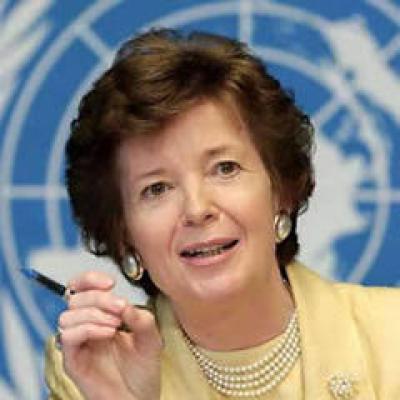
To make progress we have to build a multi-stakeholder process, harnessing the appropriate energies.
Human rights are inscribed in the hearts of people; they were there long before lawmakers drafted their first proclamation.
As a citizen of Ireland I have more sovereignty over our government. Because citizens now have more ways of holding the Irish government to account, not just under Irish constitutional law, but under the European system, at Strasbourg and Brussels. This, I believe, is the benefit for individual citizens.
The international human rights framework is a vital component and engine for promoting global values. Governments have signed up to this international legal framework and we should hold them accountable, in all circumstances from environmental or labour standards, to trade talks, arms control and security issues as well as other international legal codes.
I believe we should try to move away from the vocabulary and attitudes which shape the stereotyping of developed and developing country approaches to human rights issues. We are collective custodians of universal human rights standards, and any sense that we fall into camps of "accuser" and "accused" is absolutely corrosive of our joint purposes. The reality is that no group of countries has any grounds for complacency about its own human rights performance and no group of countries does itself justice by automatically slipping into the "victim" mode.
The term 'human rights' has been too often associated with conditionality, and with concerns of developing countries that in order to benefit from open trade they would be required to implement immediately labour and environmental standards of a comparable level to those applied in industrialised countries. At the same time, debates about the primacy of trade as against human rights legal codes have contributed to maintaining the unfortunate impression that the two bodies of law are pursuing incompatible aims.
I don't like a bipolar or a unipolar world. I like a multipolar world but on many occasions people have been surprised that South Africa has not seemed, internationally as well as internally, to take a decision that affirms the true values of your Constitution and the vision of those who were there at the beginning - Madiba himself and others.
Young persons, because of their immaturity, may not fully comprehend the consequences of their actions and should therefore benefit from less severe sanctions than adults. More importantly, it reflects the firm belief that young persons are more susceptible to change, and thus have a greater potential for rehabilitation than adults.
The burden of health care shouldn't be borne by the poorest families. We should have equity within health systems so that families are able to cope with serious illness and not be driven into poverty and relationship breakdown because they don't have access to health care.
Look, you are interested in trying to make sure that governments keep a clean environment, have regard for the lifestyles of indigenous peoples, and work for fair trade rules. Well, it's exactly the same for human rights - from non-discrimination to the basic rights to food, safe water, education and health care. We are talking rights not needs. There are standards that governments have signed up to - but nobody is holding them to account.
Democratic governments are not delivering on their promises, which is partly due to the fact that governments are less powerful than they were after the Second World War. There were fewer governments then, but they actually had more political power.
In general, I don't think that economic, social and cultural rights are primarily a matter of going to court. They are most useful today as commitments which can help ensure effective and equitable policy-making at every level.
The Great Famine is a period of our history that we need to know in great detail in order to understand its continuing impact on us as a people. Its causes were complex. We can't apportion blame simplistically but rather [must] understand that blame has to be shared in different areas and levels of society. It was the very poorest of the poor, the small tenants and cottiers, who really suffered. Others were less affected. But most of all I welcomed the commemoration because it was a moment to look into our past and realize the courage and resilience of those who survived.
Sharing experience and building public support for the full range of rights is more powerful than legal cases.
In a society where the rights and potential of women are constrained, no man can be truly free. He may have power, but he will not have freedom.
A lot of young people are very cynical about the political framework because they see the countries that preach democracy and human rights being countries largely responsible for the problems in their region.
I can see the immense capacity of business to give leadership.
Maybe this society, if anything, has become more patriarchal, and that has to be combated.
The aim of human rights, if I may borrow a term from engineering, is to move beyond the design and drawing-board phase, to move beyond thinking and talking about the foundations stones - to laying those foundation stones, inch by inch, together.
I'm coming to a sense of a women's movement which was extraordinarily important in the struggle for freedom in Ireland and immediately afterwards, but then some of those women who were involved in the movement got involved in representative positions and perhaps some of them got a bit distanced from the grassroots issues. But also the women's movement itself seemed to say, "No, we've got our own government, our own parties in power" and they sat back.
We will not let governments off the hook. We will look to civil society to help us, to pin governments, to what they have committed to here. And we will report on it.
Particularly here in the United States there is a lack of comprehension about anything to do with the United Nations.
I agree with those who argue that it is possible to distil from the religions of the world their common values and relevance. As far as I'm concerned I am involved in a complementary process with people who have a moral or spiritual commitment to human rights.
We have long had emigration in Ireland. But the nature of emigration has changed. With ferries to Britain and the continent, as well as air travel, emigration isn't the cutoff it used to be. In addition, some of our young people are being educated to levels beyond our present capacity to provide the jobs they are qualified to do. So they go abroad. Many want to come back, especially when they have children they would want to be raised in the Irish society and in the Irish educational system.
I'm not interested in scoring points or being over-critical of the US administration. I want to find the entry points to try and get it back on track so that the United States can get out of the present disastrous situation it's in, and back into being a constructive force for human rights in the world.
Freedom from discrimination for women, ensuring that female children can learn to read, these are human needs for half the human race, not western values.
If you live in a global world and you want to champion liberty in it, then you have you got to sign up to that global world.
We need more emphasis on linking jobs and economic progress with environmental issues, and not allowing environmentally damaging industries to be brought into the country simply to provide employment. It's not easy to balance.
I want to see a UN that enables a gathering of energies in which business plays its proper role.
If you are small and don't particularly want credit for what you are doing, you can achieve a lot.
Climate change is the greatest threat to human rights in the 21st century.
All countries are particular and no models are perfect.
The governments are seen to be less effective than they used to be. The private sector is perceived as being so much more efficient, and so globalization implies a transfer of power to the private sector.
Post-genocide Rwanda has managed to implement a good universal health insurance scheme that covers a large proportion of the population. This came about because of the severity of the country's problems and the resulting high proportion of women in the parliament and among professional caregivers, which had a positive effect on policy.
When globalisation means that many of the services that individual governments used to have direct power over are privatised, in education and health, even prison services, nonetheless national sovereignty still needs to be exercised.
It is a time when Irish women can link - as they are linking - through networks. They can do this through having an outward-looking attitude to what's happening to women in other countries, and by being affected by a broader debate.
We now know that climate change is a driver of migration, and is expected to increase the displacement of populations.
Finance ministers must realize that the health budget can save them money if it's applied well.
There is a democratic deficit. In Latin America in particular there is real concern that democratic governments are not delivering and that is leading to experimenting with different models that are much less democratic. But even in Western Europe the deficit is a problem.
When I am asked, "What, in your view, is the worst human rights problem in the world today?" I reply: "Absolute poverty." This is not the answer most journalists expect. It is neither sexy nor legalistic. But it is true.
An endless war against terrorism can tend to inflate the terrorists, because being at war is attractive to some angry, unemployed, disaffected youth.
The question now is how best to help the Iraqi people build a democratic and free Iraqi society that ensures respect for the rights of all Iraqis.
The changing climate is a threat to human rights.
As Elders we have great respect for all religions and traditions as important forces that bind people together. Faith and tradition provide much of the foundation of our laws and social codes. But where religion and tradition are used to justify discrimination and especially when they are used to justify cruel and harmful practices such as female genital mutilation, infanticide and child marriage, then we believe that is unacceptable.
One of the richest countries in the world - the United States of America - is facing a real ethical dilemma in terms of providing equitable access to health care.
The whole human rights structure is based on the accountability of governments.
I was elected by the women of Ireland, who instead of rocking the cradle, rocked the system.
When a genocidal killing occurs, as happened in Rwanda, it is not just an internal domestic matter.
The structures of the WTO need to be reformed to increase participation. There must be a greater sense of shared ownership of the substance of the trade negotiation agenda. Decisions about issues to be negotiated, and in which sequence they should be taken, should rest with all WTO members, not only the most powerful.
The first thing to recognize is how fortunate Ireland is to be an island off the west coast of Europe, and therefore helped by the prevailing winds to escape the effects of acid rain and other problems. We were also lucky not to have had the same kind of industrial revolution and industry as some other countries. Our problem now is to create employment, but to do it in ways that value our environment.
Many people today in the developed countries are so far removed from poverty and suffering and starvation that they lack empathy for the sufferings of others.
Feel empowered. And if you start to do it, if you start to feel your voice heard, you will never go back.
I think that we have refined greatly our notions of sovereignty in the EU. Its members consider themselves to be sovereign governments, but they have ceded a part of their sovereignty to the Union level, and their sovereignty is now penetrated by EU law.
The fossil-fuel-based development model has not benefitted all people and those who have benefitted least are now suffering great harm in the face of climate change.
If we took away barriers to women's leadership, we would solve the climate change problem a lot faster
We need to understand that we need to get the work-life balance better for both men and women - by men taking on more of those roles of homemaking and child rearing - it's an important area that we still haven't got right. I do worry; it's not just in the United States, it's also in parts of Latin America.
I was influenced at an early age by Gandhi, and I have read many biographies of him. I have been greatly influenced in the last twenty years by Mandela. It is amazing that he has managed to keep such a balance, that he came out of prison after such a long time as a rounded, holistic person who could reach difficult accommodations with generosity.
Symbols give us our identity, our self image, our way of explaining ourselves to ourselves and to others. Symbols in turn determine the kinds of stories we tell, and the stories we tell determine the kind of history we make and remake.
I don't think we in Ireland have to follow slavishly what other countries have done. Ireland has its own strengths - in family life, in the local community, in the concept of meitheal, a very traditional form of cooperation in rural Ireland. Three or four or five neighbors get together, exchanging labor, farm equipment, and so on. There are strong solidarity overtones. That tradition is being translated today into community self-development.
The MDGs have been useful in moving human rights and development discourse together and in highlighting the need for greater accountability at all levels.
Ireland is not in a good place at the moment. We have our own humiliation of losing our economic sovereignty, and we're now regaining it slowly and painfully.
We must understand the role of human rights as empowering of individuals and communities. By protecting these rights, we can help prevent the many conflicts based on poverty, discrimination and exclusion (social, economic and political) that continue to plague humanity and destroy decades of development efforts. The vicious circle of human rights violations that lead to conflicts-which in turn lead to more violations-must be broken. I believe we can break it only by ensuring respect for all human rights.
Christian fundamentalists seek to roll back women's right to choose in the United States, and then also insist that money against Aids must not go to organisations that help people obtain their reproductive rights. These are extremely worrying trends.
Tackling the issue of climate change presents us with an inflection point in human history - a climate justice revolution that separates development from fossil fuels, supports people in the most vulnerable situations to adapt, allows all people to take part, and, most importantly, realise their full potential.
We need to be prepared to have multi-stakeholder, well-managed partnerships. That can be very effective. We saw this happen at international level with the UN Convention on Landmines, for example, where some governments didn't want to go forward, but enough governments did and with them many NGOs. At international level we need to see this as the 21st century way of doing things.
It is people who go through suffering that have an empathy for the suffering of others.
Membership in the European Community, now the European Union, has enabled Ireland to re-find its sense of participation - cultural, political, social - at the European level. I think that also opens up possibilities for Ireland as a European country to look outward - to look particularly, for example, at countries to which a lot of Irish people emigrated, to our links - our human links - with the United States, with Canada, with Australia, with New Zealand. And to look also, because of our history, at our links to the developing countries.
Today's human rights violations are the causes of tomorrow's conflicts.
I'm a very wide reader. I read serious books and I read airplane, forgettable books. I never have fewer than four or five books beside my bed at night. I particularly enjoy reading about people who have gone through a personal growth.
Thanks to the European Union, Ireland has a much more open climate of discussion and debate, as you can see in the media. It means that we are a more questioning society, perhaps more honestly prepared to address serious issues and problems, more open to the idea that different viewpoints should be heard and respected.
You can convene a wider cross-section if you have no turf to defend, because then you don't cut across anyone else's agenda and you can achieve a great deal.
If the Chinese business community takes the Declaration of Human Rights, core labor standards, and environmental standards seriously, the government of China will take them far more seriously, too.
From Iraq to Guantanamo Bay, international standards and the framework of international law are being given less when they should be given more importance. I am pleased that the courts in the United States are beginning to review what has happened to those detained in Guantanamo Bay. Similarly in Iraq we need to bring our strategies back within the framework of international norms and law.
The Snow-drop, Winter's timid child, Awakes to life, bedew'd with tears.
We must encourage energy conservation and sustainable development. Young people are the ones who are most environmentally conscious in Ireland, so that to some extent they are educating their parents. They are tackling issues of waste disposal and so on. The schools help, because they put a lot of stress on environmental awareness.
The fifth province is not anywhere here or there, north or south, east or west. It is a place within each of us. It is that place that is open to the other, that swinging door which allows us to venture out and others to venture in.
It remains the task of governments to implement the fundamental human rights standards which should influence all aspects of globalisation, including even trade talks, and to be answerable for this in a democratic way. The structure is international, but the accountability is national and I would like to see that accountability being more penetrating at regional and local level, especially in federal systems.
If we want to make progress in key areas now, we have to build a multi-stakeholder process, harnessing the appropriate energies. So not only the politicians but also business, the wider civil society, and the trade union movement all have a contribution to make, whether it is at national or at international level.
People I admire have two qualities: a kind of simplicity, and generosity of spirit. It seems to me that the more impressive people are in what they have done, the simpler they tend to be in how they talk to you, or in what they say or write.
I felt when I was elected that the most important task on this island [Ireland] was to extend the hand of friendship right across the board to the people of Northern Ireland, to have the beginnings of a real peace process. In consequence, although I have no role in intergovernmental talks or political discussions, that would be my very top priority.
Membership in the European Community, now the European Union, has helped Ireland to take its place as a European country with all the member states, including Britain. It has therefore helped the maturing of a good bilateral relationship with Britain, lifting part of the burden of history.
The United Nations is actually a mid-20th century institution and much weaker than it was when it was originally created, because governments themselves are less capable of implementing the kind of promises or programs that they have put forward.
Since 9/11 the United States has been followed by countries with bad records, such as the former Soviet Union countries, into erosions of human rights. Because the United States has changed its standards it is undermining civil liberties elsewhere.
The UN may not be very effective but I am a fan of the idea of the United Nations. I have been there, I know the problems. To parody Winston Churchill: It is the worst system, except we don't have any other.
A culture is not an abstract thing. It is a living, evolving process. The aim is to push beyond standard-setting and asserting human rights to make those standards a living reality for people everywhere.
Using human rights commitments more effectively, either as part of negotiations in the WTO or as part of the trade policy review process, poses issues of equality in a practical venue.
We need a more holistic approach in which we take account of society's most vulnerable sectors. We shouldn't just do broad averaging of country statistics but rather we need to disaggregate the data to determine where the resources are most needed. In most cases, it's usually the reverse: those who are most marginalized - minorities and rural and remote communities - get the least attention and money.
The fight for human rights is about speaking truth to power.
There are some parts of the business world, in my judgment, that are actually trying to ensure that the U.S. does not take on board the preponderance of arguments for global warming, and that is something I am really very concerned about.
It is a great problem for the true international agenda of human rights that the United States, uniquely among industrialised countries, has not ratified three main instruments, has not ratified the Covenant on Economic, Social and Cultural Rights, or the Convention on the Rights of the Child, or the Convention for the Elimination of Discrimination Against Women, and we could have so much richer a debate and dialogue on international human rights standards if the superpower would sign up to the agenda.
When we see companies who are in complicit relationships with China, for example, making huge profits by providing China with the very software that enables the state to censor its own people, that is not acceptable. We need to engage with such companies to make their responsibilities clear.
Many people think that we have no shared value system in the world today but we actually do.
Ethical globalization is possible if only we can hold governments and business accountable for respecting human rights, not just in the traditional political and legal realms, but in everything - health, education and the other social determinants of health - rights to food, safe water, sanitation and so on.
Companies should increasingly see themselves as major corporate citizens with a wider responsibility to the community. Nothing less than their reputation - their image - is at stake.
I have a sense that South Africa is my other country apart from my native country that I particularly love, [that I] want to see succeed, and I did really want my message to be listened to.
There's a worldwide linking of environmental activists, developmental experts and human rights advocates. And they're using the two frameworks, in particular environmental standards and human rights.
I do not support individual countries taking military action against another country because of its human rights record, or subsequently justifying taking such action on human rights grounds.
I want to take human rights out of their box. I want to show the relevance of the universal principles of human rights to the basic needs of health, security, education and equality.
Democracy is about constant vigilance. It's not straightforward, there will always be setbacks and you get particular be it religious fundamentalists, Christian fundamentalism - a partly conservative approach and actually trying to put women in a more traditional role. And we have to resist that.
In human rights theory it is very important that governments still have the primary responsibility for the standards and provision of such services even if they no longer deliver them. They must insist that the private sector delivers without discrimination. So governments still have responsibility, including the need to influence business.
There are numerous issues that governments used to deal with that they now no longer deal with to the same extent: Prisons have been privatized in a number of countries; education and health are becoming privatized. Governments don't have the capacity to deliver - or not in isolation.
It is necessary to ensure that the requirement to combat terrorism is not used to clamp down on freedom of expression, legitimate dissent, freedom of association and so on.
South Africa is regarded as being an extraordinarily important country - not just for South Africa, but for Southern Africa, for the BRICS, working now in a new way in which power is becoming more shared - thankfully.
As Elders, we are fully committed to the principle that all human beings are of equal worth. You will see that we highlight equality for girls and women - not just women's rights. That is important as girls, especially adolescent girls, have been almost invisible in debates on equal rights. Yet it is in adolescence that events can have a huge effect on a girl's life.
It's only after their death that people are truly appreciated. It's because they are true to values.
The corporate sector per se is bottom-line oriented. It can be very corrupt and it is not very principled. That is why I don't think it is sufficient just to have voluntary codes of behavior. I am in favor of legislation which helps to ensure that there is an even playing field and rewards those who play by the rules.
Every government has signed up to a voluntary legal commitment under at least one of the international covenants and conventions based on the Universal Declaration of Human Rights. But who is holding them to account? Our mission is to make it known that these conventions are good tools for civil society to hold their local authority, their government and businesses accountable.
I'm struck by how very few people outside a rarefied world of true believers understand what you mean when you say human rights - that includes development experts and economists who are very keen to implement the UN Millennium Development Goals. They've told me quite frankly, that they don't know exactly what a human rights approach is.