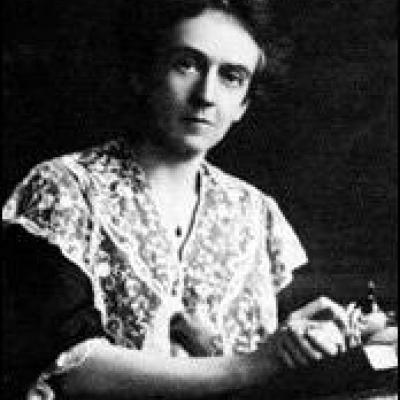
The Old Testament is the record of men's conviction that God speaks directly to men.
No facts, however indubitably detected, no effort of reason, however magnificently maintained, can prove that Bach's music is beautiful.
To be able to be caught up into the world of thought-that is educated.
A people's literature is the great text-book for real knowledge of them.
The easy way has never in the long run commanded the allegiance of mankind.
The fullness of life is in the hazards of life. And, at the worst, there is that in us which can turn defeat into victory.
sooner or later, if the activity of the mind is restricted anywhere it will cease to function even where it is allowed to be free.
A people's literature is the great textbook for real knowledge of them. The writings of the day show the quality of the people as no historical reconstruction can.
When the mind withdraws into itself and dispenses with facts it makes only chaos.
When the freedom they wished for most was freedom from responsibility, then Athens ceased to be free and was never free again.
Responsibility is the price every man must pay for freedom.
Mind and spirit together make up that which separates us from the rest of the animal world, that which enables a man to know the truth and that which enables him to die for the truth.
We must not contradict, but instruct him that contradicts us; for a madman is not cured by another running mad also. To be able to be caught up into the world of thought -- that is being educated.
though the outside of human life changes much, the inside changes little, and the lesson-book we cannot graduate from is human experience.
The greater the suffering depicted, the more terrible the events, the more intense our pleasure.
All things are at odds when God sets a thinker loose on the planet
The heterodoxy of one generation is the orthodoxy of the next.
To rejoice in life, to find the world beautiful and delightful to live in, was a mark of the Greek spirit which distinguished it from all that had gone before. It is a vital distinction.
Christ must be rediscovered perpetually.
When faith is supported by facts or by logic it ceases to be faith.
There are few efforts more conducive to humility than that of the translator trying to communicate an incommunicable beauty. Yet, unless we do try, something unique and never surpassed will cease to exist except in the libraries of a few inquisitive book lovers.
In theology the conservative temper tends to formalism.
Moderately wise each one should be, Not overwise, for a wise man's heart Is seldom glad (Norse Wisdom)
One form of religion perpetually gives way to another; if religion did not change it would be dead. ... Each time the new ideas appear they are seen at first as a deadly foe threatening to make religion perish from the earth; but in the end there is a deeper insight and a better life with ancient follies and prejudices gone.
Great art is the expression of a solution of the conflict between the demands of the world without and that within.
...a chasm opened in the earth and out of it coal-black horses sprang, drawing a chariot and driven by one who had a look of dark splendor, majestic and beautiful and terrible. He caught her to him and held her close. The next moment she was being borne away from the radiance of earth in springtime to the world of the dead by the king who rules it.
He was there beside her, yet she was far away from him, aone with her outraged love and her ruined life.
... clear thinking is not the characteristic which distinguishes our literature today. We are more and more caught up by the unintelligible. People like it. This argues an inability to think, or, almost as bad, a disinclination to think.
The anthropologists are busy, indeed, and ready to transport us back into the savage forest where all human things ... have their beginnings; but the seed never explains the flower.
Our word 'idiot' comes from the Greek name for the man who took no share in public matters.
There is no better indication of what the people of any period are like than the plays they go to see.
The fundamental facts about the Greek was that he had to use his mind. The ancient priest had said, "Thus far and no farther. We set the limits of thought." The Greeks said, All things are to be examined and called into question. There are no limits set on thought.
When I read educational articles it often seems to me that this important side of the matter, the purely personal side, is not emphasized enough; the fact that it is so much more agreeable and interesting to be an educated person than not. The sheer pleasure of being educated does not seem to be stressed.
There is a field where all wonderful perfections of microscope and telescope fail, all exquisite niceties of weights and measures, as well as that which is behind them, the keen and driving power of the mind. No facts however indubitably detected, no effort of reason however magnificently maintained, can prove that Bach's music is beautiful.
..,No love cannot leave where there is no trust..,~cupid and psyche..,"Greek mythology of Edith Hamilton
A tendency to exaggeration was a Roman trait.
The Greek temple is the creation, par excellence, of mind and spirit in equilibrium.
It has always seemed strange to me that in our endless discussions about education so little stress is laid on the pleasure of becoming an educated person, the enormous interest it adds to life. To be able to be caught up into the world of thought-that is to be educated.
The power of good is shown not by triumphantly conquering evil, but by continuing to resist evil while facing certain defeat.
The suffering of a soul that can suffer greatly -- that and only that, is tragedy.
Reality has actually very little to do with truth; there is no necessary connection between the two.
Freedom was born in Greece because there men limited their own freedom. ... The limits to action established by law were a mere nothing compared to the limits established by a man's free choice.
So far, we do not seem appalled at the prospect of exactly the same kind of education being applied to all the school children from the Atlantic to the Pacific, but there is an uneasiness in the air, a realization that the individual is growing less easy to find; an idea, perhaps, of what standardization might become when the units are not machines, but human beings.
None but a poet can write a tragedy. For tragedy is nothing less than pain transmuted into exaltation by the alchemy of poetry.
Convention, so often a mask for injustice.
Ages of faith and of unbelief are always said to mark the course of history.
Uncertainty is the prerequisite to gaining knowledge and frequently the result as well.
Myths are early science, the result of men's first trying to explain what they saw around them.
The Greeks were the first intellectualists. In a world where the irrational had played the chief role, they came forward as the protagonists of the mind.
A word is no light matter. Words have with truth been called fossil poetry, each, that is, a symbol of a creative thought.
It was a Roman who said it was sweet to die for one's country. The Greeks never said it was sweet to die for anything. They had no vital lies.
Poetry and preaching do not go well together; when the preacher mounts the pulpit the poet usually goes away.
In every civilization, life grows easier. Men grow lazier in consequence. We have a picture of what happened to the individual Greek. (I cannot look at history, or at any human action, except as I look at the individual.) The Greeks had good food, good witty talk, pleasant dinner parties; and they were content. When the individual man had reached that condition in Athens, when the thought not of giving to the state but of what the state could give to him, Athens' freedom was doomed.
Love and the Soul (for that is what Psyche means) had sought and, after sore trials, found each other; and that union could never be broken. (Cupid and Psyche)
The modern minds in each generation are the critics who preserve us from a petrifying world, who will not leave us to walk undisturbed in the ways of our fathers.
When we speak of beauty, we're speaking of something we're more or less indifferent to.
Love, however, cannot be forbidden. The more that flame is covered up, the hotter it burns. Also love can always find a way. It was impossible that these two whose hearts were on fire should be kept apart. (Pyramus and Thisbe)
To rejoice in life, to find the world beautiful ... was a mark of the Greek spirit.
Love cannot live where there is no trust.
The temper of mind that sees tragedy in life has not for its opposite the temper that sees joy. The opposite pole to the tragic view of life is the sordid view.
Old ideas are continually being slain by new facts. There is nothing stable in the conclusions of the mind, and it is impossible that there ever should be unless we hold that the universe is made to the measure of the human mind, an assumption for which nothing in the past gives any warrant.
Civilization...is a matter of imponderables, of delight in the thins of the mind, of love of beauty, of honor, grace, courtesy, delicate feeling. Where imponderables, are things of first importance, there is the height of civilization, and, if at the same time, the power of art exists unimpaired, human life has reached a level seldom attained and very seldom surpassed.
The fullness of life is in the hazards of life.
None so good that he has no faults, None so wicked that he is worth naught.
Pain is the most individualized thing on earth. It is true that it is the great common bond as well, but that realization only comes when it is over. To suffer is to be alone. To watch another suffer is to know the barrier that shuts each of us away by himself Only individuals can suffer.
Faith is not belief. Belief is passive. Faith is active.
They were the first Westerners. The spirit of the West, the modern spirit, is a Greek discovery; and the place of the Greeks is in the modern world.
There is no dignity like the dignity of a soul in agony.
The comedy of each age holds up a mirror to the people of that age, a mirror that is unique.
Theories that go counter to the facts of human nature are foredoomed.
I came to the Greeks early, and I found answers in them. Greece's great men let all their acts turn on the immortality of the soul. We don't really act as if we believed in the soul's immortality and that's why we are where we are today.
The mind knows only what lies near the heart.
When the world is storm-driven and bad things happen, then we need to know all the strong fortresses of the spirit which men have built through the ages.
It is not hard work that is dreary; it is superficial work.
Tell one your thoughts, but beware of two. All know what is known to three
Through Plato, Aristotle came to believe in God; but Plato never attempted to prove His reality. Aristotle had to do so. Plato contemplated Him; Aristotle produced arguments to demonstrate Him. Plato never defined Him; but Aristotle thought God through logically, and concluded with entire satisfaction to himself that He was the Unmoved Mover.