Balthus: Biography and Life Work
Balthus was a notable Polish-French modern artist. The story of Balthus began on February 29, 1908 in Paris, France. The legacy of Balthus continues today, following their passing on February 18, 2001 in Rossinière, Switzerland.
Balthasar Klossowski ( French: ; February 29, 1908 – February 18, 2001), also known as Balthus ( French: ), was a Polish-French modern artist . He is known for his erotically charged images of young girls, and the dreamlike quality of his imagery.
Legacy and Personal Influence
Personally, Balthus was married to Antoinette de Watteville (divorced), Setsuko Klossowska de Rola. Historically, their work is best remembered for Painting.
Major Contributions
- Painting
- drawing
- watercolor
Philosophical Views and Reflections
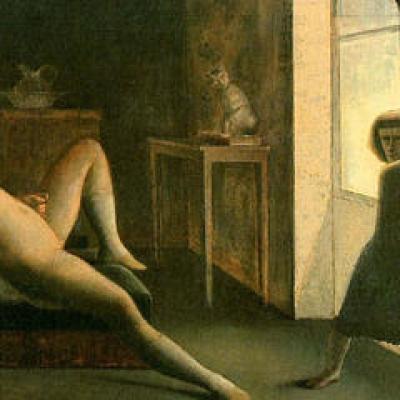
In 1940, with the invasion of France by German forces, Balthus fled with his wife Antoinette to Savoy to a farm in Champrovent near Aix-les-Bains , where he began work on two major paintings: Landscape near Champrovent (1942–1945) and The Living Room (1942). In 1942, he escaped from Occupied France to Switzerland, first to Bern and in 1945 to Geneva , where he became a friend of the publisher Albert Skira as well as the writer and member of the French Resistance , André Malraux . Balthus returned to France in 1946 and a year later traveled with André Masson to Southern France , meeting figures such as Picasso and Jacques Lacan , who eventually became a collector of his work. With Adolphe Mouron Cassandre in 1950, Balthus designed stage decor for a production of Mozart 's opera Così fan tutte in Aix-en-Provence . Three years later he moved into the Chateau de Chassy in the Morvan , living with his step-niece Frédérique Tison and finishing his large-scale paintings La Chambre ( The Room 1952, possibly influenced by Pierre Klossowski 's novels) and Le Passage du Commerce Saint-André (1954).
Balthus held his first exhibition at Galerie Pierre, Paris, in 1934. Following the ensuing scandal, he exhibited at the Pierre Matisse Gallery, New York, from 1938 to 1977, although he never visited the United States. Balthus's first major museum exhibition was at the Museum of Modern Art in 1956. Other museum exhibitions of note include Musée des Arts Decoratifs , Paris (1966); Tate Gallery , London (1968); La Biennale di Venezia (1980); Museum of Contemporary Art , Chicago (1980); Musée cantonal des beaux-arts de Lausanne (1993); Musée d'Art Moderne de la Ville de Paris (1984, traveled to Metropolitan Museum, Kyoto); Metropolitan Museum of Art , New York (1984); and Palazzo Grassi , Venice (2001). "Balthus: Cats and Girls: Paintings and Provocations" at the Metropolitan Museum of Art (September 25, 2013 – January 12, 2014) was the first U.S. museum survey of the artist's work in 30 years. A major retrospective overseen by the artist's wife, Ideta Setsuko, was held in 2014 at the Tokyo Metropolitan Art Museum . An exhibition of Polaroid photographs taken by Balthus at the Museum Folkwang in Essen , Germany, was canceled over accusations of pedophilia . The German newspaper Die Zeit called the images, which depict a model named Anna from ages eight to 16, “documents of pedophile greed.” Since then, despite attempts, no planned exhibition of Balthus’s work was censored or cancelled for such allegations.