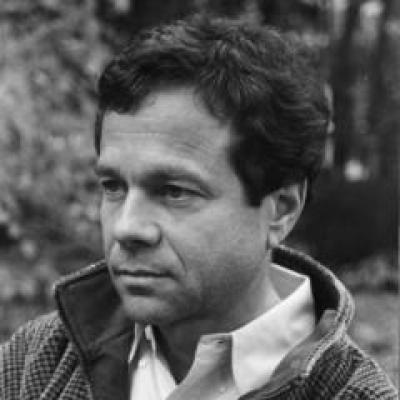
Oh, love is very much a physical thing.... I realize that it's very complicated, and I'm sure it can't be traced to individual neurons and hormones, but I think it's very much a physiological sensation that takes place in the brain.
I value my correspondence with writers...I was in New York and had lunch with Oliver Sachs and compared notes with him - he is someone I really like. I love staying in written correspondence with some writers. That's enough for me.
And at the place where time stands still, one sees lovers kissing in the shadows of buildings, in a frozen embrace that will never let go. The loved one will never take his arms from where they are now, will never give back the bracelet of memories, will never journey afar from his lover, will never place himself in danger of self-sacrifice, will never fail to show his love, will never become jealous, will never fall in love with someone else, will never lose the passion of this instant of time.
With infinite life comes an infinite list of relatives. Grandparents never die, nor do great grandparents, great-aunts…and so on, back through the generations, all alive and offering advice. Sons never escape from the shadows of their fathers. Nor do daughters of their mothers. No one ever comes into his own…Such is the cost of immortality. No person is whole. No person is free.
Events, once happened, lose reality, alter with a glance, a storm, a night. In time, the past never happened. But who could know? Who could know that the past is not as solid as this instant.
In a world in which time is a circle, every handshake, every kiss, every birth, every word, will be repeated precisely.
Nature is purposeless. Nature simply is. We may find nature beautiful or terrible, but those feelings are human constructions. Such utter and complete mindlessness is hard for us to accept. We feel such a strong connection to nature. But the relationship between nature and us is one-sided. There is no reciprocity. There is no mind on the other side of the wall.
Continents of memory had been lost.
In this world, artists are joyous. Unpredictability is the life of their paintings, their music, their novels. They delight in events not forecasted, happenings without explanation, retrospective.
"The Diagnosis" had ten drafts of very significant changing, where I went through the whole book, wholesale and changed everything. Then the last year or so it was making small changes. I would do something and let it sit for three months... just brood about and decide I needed to slightly change something here or there. Or one character wasn't quite right. But I think everybody goes through this.
Despite our strongly felt kinship and oneness with nature, all the evidence suggests that nature doesn't care one whit about us. Tornadoes, hurricanes, floods, earthquakes and volcanic eruptions happen without the slightest consideration for human inhabitants.
Sadness is no more than a bit of acid transfixed in the cerebellum.
I have for a long time loved fabulist, imaginative fiction, such as the writing of Italo Calvino, Jose Saramago, Michael Bulgakov, and Salman Rushdie. I also like the magic realist writers, such as Borges and Marquez, and feel that interesting truths can be learned about our world by exploring highly distorted worlds.
I would think that you are more fluent with the rational. It has its appeal. But the irrational permits a greater exercise of ... shall we say, power.
I have too many friends who tell me that they spend the first hour of every morning going through their e-mail messages. I'd like to use my time more carefully.
It is a world of impulse. It is a world of sincerity. It is a world in which every word spoken speaks just to that moment, every glance given has only one meaning, each touch has no past or no future, each kiss is a kiss of immediacy.
The relationship between science and the humanities is two-way. Science changes our view of the world and our place in it. In the other direction, the humanities provide the store of ideas and images and language available to us in understanding the world. The exploding star of A.D. 1054, the Crab Nebula, was sighted and documented by the Chinese, but nowhere mentioned in the West, where the Aristotelian notion of the immortality of stars still held sway. We often do not see what we do not expect to see.
Time is the clarity for seeing right and wrong.
Music is, of course, a universal emotional experience, cutting across cultures and languages. I studied piano for ten years as a child and consider that experience one of the most valuable in my life.
There is a place where time stands still ...illuminated by only the most feeble red light, for light is diminished to almost nothing at the center of time, its vibrations slowed to echoes in vast canyons, its intensity reduced to the faint glow of fireflies.
Writers are a loosely knit community - community is an overstated word. Writers don't see each other very much.
As a scientist, I don't believe science will ever discover whether God exists. Nor do I believe religion will ever prove it.
Don't you feel something magical when you're in love?... I do, I certainly do ... but I think that feeling of magic is a hardwired psychological response. It's a chemical thing in the brain. It's a flow of chemicals and electrical currents, and it developed over millions of years in the process of evolution to aid in the procreation of the species.
Who would fare better in this world of fitful time? Those who have seen the future and live only one life? Or those who have not seen the future and wait to live life? Or those who deny the future and live two lives?
Science is an intellectual journey, and to me, it's not the destination, it's the journeyto get there. It's a way of thinking and it's an intellectual curiosity, a desire to know how the world works, and to know what the fundamental principles of the world are, and to know our place in it. I think once we stop asking questions like "what is the age of the universe," or "how are the instructions of DNA carried out on a microscopic level," once we stop asking questions like that, we're dead.
If a person holds no ambitions in this world, he suffers unknowingly. If a person holds ambitions, he suffers knowingly, but very slowly.
The tragedy of this world is that everyone is alone. For a life in the past cannot be shared with the present.
The time-deaf are unable to speak what they know. For speech needs a sequence of words, spoken in time.
I think what gets you through a small writing project, is just one burst of inspiration. A book, especially a longer book, it's a different kind of force that pushes you through it. It's a vision of the whole thing.
We live in a highly polarized society. We need to try to understand each other in respectful ways. To that end, I believe that we should make room for both spiritual atheists and thinking believers.
A world in which time is absolute is a world of consolation. For while the movements of people are unpredictable, the movement of time is predictable. While people can be doubted, time cannot be doubted. While people brood, time skips ahead without looking back.
In this world, time has three dimensions, like space. Just as an object may move in three perpendicular directions, corresponding to horizontal, vertical, and longitudinal, so an object may participate in three perpendicular futures. Each future moves in a different direction of time. Each future is real. At every point of decision, the world splits into three worlds, each with the same people, but different fates for those people. In time, there are an infinity of worlds.
A person who cannot imagine the future is a person who cannot contemplate the results of his actions. Some are thus paralyzed into inaction.
In this world, there are two times. There is mechanical time and there is body time." "They do not keep clocks in their houses. Instead, they listen to their heartbeats. They feel the rhythms of their moods and desires." "Then there are those who think their bodies don't exist. They live by mechanical time. They rise at seven o'clock in the morning. They eat their lunch at noon and their supper at six. They arrive at their appointments on time, precisely by the clock.
Although technology is proceeding at a dizzying pace, I believe that the human mind will always have control of itself. And since the human mind has a degree of infinity and imagination unlikely to be matched by a machine for a very, very long time, I don't think that we will become the machines of the machines.
My writings are an exploration, and I think a lot of writers would tell you this, but in writing, you're not simply putting down things that are already known to you. You're actually discovering in the writing process, you're actually creating knowledge.
Children grow rapidly, forget the centuries-long embrace from their parents, which to them lasted but seconds. Children become adults, live far from their parents, live their own houses, learn ways of their own, suffer pain, grow old. Children curse their parents for their wrinkled skin and hoarse voices. Those now old children also want to stop time, but at another time. They want to freeze their own children at the center of time.
One metaphor for how we are living is that you see so may people with cell phones. In restaurants, walking, they have cell phones clamped to their to heads. When they are on their cell phones they are not where their bodies are...they are somewhere else in hyperspace. They are not grounded. We have become disembodied. By being always somewhere else we are nowhere.
As long as God does not intervene in the contemporary universe in such a way as to violate physical laws, science has no way of knowing whether God exists or not. The belief or disbelief in such a Being is therefore a matter of faith.
I oppose any belief that contradicts experimental evidence as determined by the methods of science. All beliefs not in such contradiction may be considered as faith. Whether faith in a particular belief is beneficial or not is another matter.
A world in which time is absolute is a world of consolation. For while the movements of people are unpredictable, the movement of time is predictable. While people can be doubted, time cannot be doubted. While people brood, time skips ahead without looking back. In the coffee houses, in the government buildings, in boats of Lake Geneva, people look at their watches and take refuge in time. Each person knows that somewhere is recorded the moment she was born, the moment she took her first step, the moment of her first passion, the moment she said goodbye to her parents.
If you over-plot your book you strangle your characters. Your characters have to have enough freedom and life to be able to surprise you.
I think e-mail is representative of our fast food mentality in the United States, where everything has gotten faster and faster, and we're required to respond to inputs more quickly with less time for thought and reflection. I believe that we need to slow down.
Such is the cost of immortality. No person is whole. No person is free. Over time, some have determined that the only way to live is to die. In death, a man or a woman is free of the weight of the past [and the future].
In our constant search for meaning in this baffling and temporary existence, trapped as we are within our three pounds of neurons, it is sometimes hard to tell what is real. We often invent what isn't there. Or ignore what is. We try to impose order, both in our minds and in our conceptions of external reality. We try to connect. We try to find truth. We dream and we hope. And underneath all of these strivings, we are haunted by the suspicion that what we see and understand of the world is only a tiny piece of the whole.
But what is the past? Could it be, the firmness of the past is just illusion? Could the past be a kaleidoscope, a pattern of images that shift with each disturbance of a sudden breeze, a laugh, a thought? And if the shift is everywhere, how would we know?
For me, consciousness is the most interesting unsolved problem of science, and, in fact, we may never know what it is about a particular arrangement of neurons that gives rise to consciousness. Our consciousness, like the air we breathe or like the passage of time, is central to our existence as intelligent beings.
In a world without future, each parting of friends is a death. In a world without future, each loneliness is final. In a world without future, each laugh is the last laugh. In a world without future, beyond the present lies nothingness, and people cling to the present as if hanging from a cliff.
A writer is someone who has a one-man tent in the desert and occasionally he sees the footprint of an other writer - in the form of a review or something.
Where are the one billion people who lived and breathed in the year 1800, only two short centuries ago?
"The Diagnosis" is by far my most ambitious book. I such great hopes for it... there was so much I wanted to do with the book. I was extremely insecure about it for several years. Just didn't know whether I would finish the book much less for it to come close to what I intended. I think that for any novel you never know exactly how the book is going to turn out...
When the first mechanical clocks were invented, marking off time in crisp, regular intervals, it must have surprised people to discover that time flowed outside their own mental and physiological processes. Body time flows at its own variable rate, oblivious to the most precise hydrogen master clocks in the laboratory. In fact, the human body contains its own exquisite time-pieces, all with their separate rhythms. There are the alpha waves in the brain; another clock is the heart. And all the while tick the mysterious, ruthless clocks that regulate aging.
Most people have learned to live in the moment. The argument goes that if the past has uncertain effect on the present, there is no need to dwell on the past. And if the present has little effect on the future, present actions need not be weighed for their consequence. Rather, each act is an island in time, to be judged on its own. ... It is a world of impulse. It is a world of sincerity. It is a world in which every word spoken speaks just to that moment, every glance given has only one meaning.
The world is moving faster and faster, but where are we going?
Each person who gets stuck in time gets stuck alone.
A good book changes for you every few years because you are in a different place in your own life. That's a sign of a good novel. Not only will two different readers get something different but so will a single reader at different points in his life.
I have no opposition at all to technology. I think technology is a wonderful thing that has to be used thoughtfully, and we can't just assume that every bit of new technology improvesthe quality of life; it's really in how the technology is used. What I am very disturbed about is this trend of everything happening faster and faster and faster and there being more and more general noise in the world, and less and less time for quiet reflection on who we are, and where we're going.
I still will sit down at the piano and play when I am wrestling with something emotionally or just want to move into the musical world.
Novels aren't pedagogical instruments, or instructions in law or physics or any other discipline. A novel has to be an emotional experience, a trip of the imagination, and because science has raised so many issues that concern and affect humans, it's a good starting place for me.
I think that the scienti?c way of looking at the world, and the humanistic way of looking at the world are complementary. There are important differences which should be preserved, and in trying to do away with those differences we would lose something the same way as if we tried to make all religions one religion or all races one race. There is a cultural diversity that's very valuable, and it's valuable to have different ways of looking at the world.
Order is the law of nature, the universal trend, the cosmic direction. If time is an arrow, that arrow points toward order. The future is pattern, organization, union, intensification; the past, randomness, confusion, disintegration, dissipation.
No one ever expects poetry to sell...
In this acausal world, scientists are helpless. Their predictions become postdictions- Their equations become justifications, their logic, illogic. Scientists turn reckless and mutter like gamblers who cannot stop betting. Scientists are buffoons, not because they are rational but because the cosmos is irrational. Or perhaps it is not because the cosmos is irrational but because they are rational. Who can say which, in an acausal world?
Time is a rigid, bonelike structure, extending infinitely ahead and behind, fossilizing the future as well as the past.
One cannot walk down an avenue, converse with a friend, enter a building, browse beneath the sandstone arches of an old arcade without meeting an instrument of time. Time is visible in all places. Clock towers, wristwatches, church bells divide years into months, months into days, days into hours, hours into seconds, each increment of time marching after the other in perfect succession. And beyond any particular clock, a vast scaffold of time, stretching across the universe, lays down the law of time equally for all.
You say, "Something important really happened here. I really had hold of something I was visited by the muse." And that's enough to make you continue the months and years to finish the whole book.
In a world without future, each moment is the end of the world.
Some make light of decisions, arguing that all possible decisions will occur. In such a world, how could one be responsible for his actions? Others hold that each decision must be considered and committed to, that without commitment there is chaos. Such people are content to live in contradictory worlds, so long as they know the reason for each.
I have always loved magic realism as a form of writing. I have also been fascinated for a long time with the intersection of science and religion.
What sense is there in continuing when one has seen the future?
-But rational thoughts lead only to rational thoughts, whereas irrational thoughts lead to new experiences.
Unconditional love. That’s what he wants to give her and what he wants from her. People should give without wanting anything in return. All other giving is selfish. But he is being selfish a little, isn’t he, by wanting her to love him in return? He hopes that she loves him in return. Is it possible for a person to love without wanting love back? Is anything so pure? Or is love, by its nature, a reciprocity, like oceans and clouds, an evaporating of seawater and a replenishing of rain?
Every essay - the subject matter of every essay - is ultimately about the essayist; him or herself. That ultimately, every essayist is writing about his or her view of the world.
We often do not see what we do not expect to see.
Suppose time is a circle, bending back on itself. The world repeats itself, precisely, endlessly.
Except for a God who sits down after the universe begins, all other gods conflict with the assumptions of science.
For my students who are trying to learn the craft of writing in a writing class - contemporary literature is what's most useful.
It's not necessarily a large number of people that affect the culture. You don't count the number of influential voices, you weigh them. A hundred people can affect the culture.
All writers have roots they draw from - travel, work, family. My roots are in science and it is fertile ground for fiction.
The urge to discover, to invent, to know the unknown, seems so deeply human that we cannot imagine our history without it.
Each time is true, but the truths are not the same.
While people brood, time skips ahead without looking back.
With a background in science I am extremely interested in the meeting ground of science, theology, and philosophy, especially the ethical questions at the border of science and theology.
I re-read a lot of books that I like a lot. There are some books that I try to reread every couple of years. A good book changes for you every few years because you are in a different place in your own life.
Imagine a world in which there is no time. Only images.
For it is only habit and memory that dulls the physical passion. Without memory, each night is the first night, each morning is the first morning, each kiss and touch are the first.
In this world, there are two times. There is mechanical time and there is body time. The first is as rigid and metallic as a massive pendulum of iron that swings back and forth, back and forth, back and forth. The second squirms and wriggles like a bluefish in a bay. The first is unyielding, predetermined. The second makes up its mind as it goes along.
Thoughts are no more than electrical surges in the brain. Sexual arousal is no more than a flow of chemicals to certain nerve endings. Sadness is no more than a bit of acid transfixed in the cerebellum. In short, the body is a machine, subject to the same laws of electricity and mechanics as an electron or clock.
The target of power is more interesting than its quantity.
I consider myself a spiritual atheist. I certainly believe there are forces bigger than ourselves, and that we should be searching, individually, for meaning in our lives. But I don't believe there's a supreme being, an intelligence that created everything.
For me, spirituality includes the belief in things larger than ourselves, an appreciation of nature and beauty, a sensitivity to the world, a feeling of shared connection with other living things, a desire to help people less fortunate than ourselves. All of these things can occur with or without God. I do not believe in the existence of God, but I consider myself a spiritual person in the manner I have just described. I call myself a spiritual atheist. I would imagine that many people are spiritual atheists.
A life is a moment in season. A life is one snowfall. A life is one autumn day. A life is the delicate, rapid edge of a closing door's shadow. A life is a brief movement of arms and of legs.
I have a number of vague ideas where I just have the core or kernel of the idea. I feel like I need some time for my mind to fill up again. I feel empty. Right now.
Some say it is best not to go near the center of time. Life is a vessel of sadness, but is noble to live life and without time there is no life. Others disagree. They would rather have an eternity of contentment, even if that eternity were fixed and frozen, like a butterfly mounted in a case.
I'm still happy with the way Einstein's Dreams came out. That book came out of a single inspiration. I really felt like I was not creating the words, that I was hearing the words. That someone else was speaking the words to me and I was just writing them down. It was a very strange experience. That can happen with a short book. I don't think it could happen with a long book.
I should have written books instead of reading them.
As I understand it, a universe is a ... well, a totality. A universe is everything that is, as far as the inside of the thing.
We're plugged in 24 hours a day now. We're all part of one big machine, whether we are conscious of that or not. And if we can't unplug from that machine, eventually we're going to become mindless.
Human beings consider themselves satisfied only compared to some other condition. A man who has owned nothing but a bicycle all of his life feels suddenly wealthy the moment he buys an automobile...But this happy sensation wears off. After a while the car becomes just another thing that he owns. Moreover, when his neighbor next door buys two cars, in an instant our man feels wretchedly poor and deprived.
As both a scientist and a humanist myself, I have struggled to understand different claims to knowledge, and I have eventually come to a formulation of the kind of religious belief that would, in my view, be compatible with science.
The tragedy of this world is that no one is happy, whether stuck in atime of pain or of joy. The tragedy of this world is that everyone is alone. For a life in the past cannot be shared with the present. Each person who gets stuck in time gets stuck alone.
Everyone shares the same fate.
Is it possible for a person to love without wanting love back? Is anything so pure? Or is love, by its nature, a reciprocity, like oceans and clouds, an evaporating of seawater and a replenishing by rain?
The tragedy of this world is that no one is happy, whether stuck in a time of pain or joy.
The book is finished by the reader. A good novel should invite the reader in and let the reader participate in the creative experience and bring their own life experiences to it, interpret with their own individual life experiences. Every reader gets something different from a book and every reader, in a sense, completes it in a different way.
I am spellbound by the plays of Shakespeare. And I am spellbound by the second law of thermodynamics. The great ideas in science, like the Cro-Magnon paintings and the plays of Shakespeare, are part of our cultural heritage.
The Book of Telling tells of a woman's journey to uncover the secret life of her father and to find herself in the process, an unusual counterpoint between personal history and the history of a young nation. Haunting, powerful, and beautifully written.
Every reader gets something different from a book and every reader, in a sense, completes it in a different way.
As human beings, don't we need questions without answers as well as questions with answers, questions that we might someday answer and questions that we can never answer?
In a world of fixed future, life is an infinite corridor of rooms, one room lit at each moment, the next room dark but prepared. We walk from room to room, look into the room that is lit, the present moment, then walk on. We do not know the rooms ahead, but we know we cannot change them. We are spectators of our lives.
No one knows the nature of God, or even if God exists. In a sense, all of our religions are literary works of the imagination.
The history of science can be viewed as the recasting of phenomena that were once thought to be accidents as phenomena that can be understood in terms of fundamental causes and principles.
I've taken a philosophical position on e-mail. Although I think it's a wonderful communication technology, and it has a lot of good uses, it is abused quite a lot.
People are content to live in contradictory worlds, so long as they know the reason for each.
We've lost our way, we have lost our centeredness. We don't have the time, literally, to think during the day. To listen to ourselves think. To think about where we are going, who we are, what's important. I would bet most people don't have thirty minutes in a day where they can just sit down and think. Or maybe they don't have to be sitting, they can be walking.
Faith is the ability to honor stillness at some moments, and at others to ride the passion and exuberance.
A world with one month is a world of equality.
You've made something grand, but it will be grander if it has feeling and beauty and harmony.
The world is moving faster and faster, but where are we going?I think one of the reasons why things are getting blurry is because there is not much meaning.
If I were not a writer, I would spend more time doing the things that I am already doing, which include doing research in physics, teaching, and running a nonprofit organization with a mission to empower women in Cambodia.
I think Joe Leiberman has been one of the leaders of the country... people have such a broad respect for him as a moral force.
That has been the great achievement of our age: to so thoroughly flood the planet with megabits that every image and fact has become a digitized disembodied nothingness. With magnificent determination, our species has advanced from Stone Age to Industrial Revolution to Digital Emptiness. We've become weightless, in the bad sense of the word.
Scientists will forever have to live with the fact that their product is, in the end, impersonal.
Unfortunately, public debates do not have much room for subtlety. The audience wants a quick thrust at your opponent, not a slow and convoluted series of moves. Whenever Obama uses subtleties in discussing a complex issue, he gets creamed.
So many little lives, amounting to nothing. I ask you: What is infinity multiplied by zero? It is hardly worth our discussion.