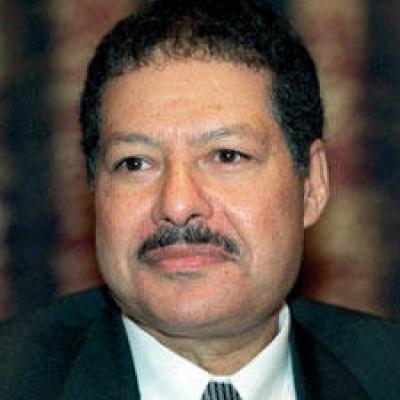
Although the Nasser revolution of 1952 was secular, the culture remained deeply religious - but it was a faith of moderation and tolerance. Women made up nearly half my class at university, and my senior academic adviser there was a woman. In Alexandria, my friends were Christians and Muslims.
I do feel that there are tremendous amount of talent in Egypt, human resources.
I found with my students they don't necessarily look at journals any more, but they print right away from the internet what's relevant to what's he doing you see.
I thought in my Nobel Lecture I pointed that I was delighted that the Swedish Academy of Science did not quote anything about my current work right now, because the current work that my group is focusing on is actually both the time resolve electrons and possibly x-rays to be able to get the architecture of these molecules, the molecular structures themselves, of very complex biological systems. That's the ultimate goal.
I think the Nobel Prize helps for a number of reasons. Number one, if I can be frank, there is these people will feel by getting a Nobel Prize that I'm one of them, that it is possible to contribute on the world map of science and technology. And the other thing also which I'm hoping for is that the government in Egypt is willing and interested in promoting science and technology and this is an ideal time now to be able to do something.
One of the things I enjoy most is to be left alone with a book.
There is a danger one has to really be knowing much more because you can't be too narrow on science.
I am not one of the new media experts working all the time with my computers and the PowerPoint's and things of that sort. So, I'm an old fashioned still in this regard but these are the moment where I really can be creative, if I am, to be left alone with just a book and piece of paper and to be thinking.
Syria is the proud heir of an ancient civilization that has a unique spectrum of minorities that encompasses Muslims and Christians of various denominations. There are at least ten such ethnic and religious groups.
Everybody thinks some times that science is done as a master plan and that somebody like me came from Mars and figured out everything and so on, but that's really not the way it worked.
When I give a lecture on Egypt there are thousands of people in the lecture hall, so obviously they would like to go to science and they would love to do science, but you really have to get the correct science base in order for them to interact.
When they called me with the Nobel call from Secretary General of the Swedish Academy it was twenty minutes to six and he said well that was well hope I'm not disturbing you but I am the Secretary General of the Swedish Academy. Of course you can imagine I was frozen in time when he said that but then he made a very famous statement, something to the effect that this is the last 20 minutes of peace of your life.
Think about the whole world of biological complex sciences. We still don't understand the way a protein folds the way it does.
For me to sit down here, even as a Nobel Laureate and make a prediction about which science I think that will be a mistake.
You should have some time to think and that's very important.
I built on the efforts of a previous scientist, others will build on the work I'm doing and if I look at the whole scope from chemistry to biology to physics, it's just the list is too long to mention just one and it's not fair to the others.
I do have a concern however, humanity has a great way of adapting and I'm sure scientists of the future, probably after I leave this planet, earth will have a new way of dealing with the internet but I do have a concern in the transition period.
When I was a child, I thought of my Delta town as the center of the universe, but now I realize how little I know about the universe. As a child, I thought I was immortal, but now I recognize how limited a time we all have. As a child, success meant scoring A on every exam, but now I take it to mean good health, close family and friends, achieve- ments in my work, and helping others.
I want to really focus on doing this two things I really would like to focus on science and the excitement of science and to help with science. So, that's my intention to focus my efforts there and I hope I will be able to do so.
We still don't understand how the big bang and evolving all the way to the human species and so on. So all of this is going to be a very, very exciting to the new people.
I don't know all the reasons for these achievements, but I know that I love what I do and I have never wanted to rest on my laurels.
I do feel quite strongly about this that probably one of the things that unfortunately this age now to get a Nobel Prize is to really use part of it to help the young people get excited about science.
Perhaps the most valuable thing he taught me (his father) was that there is no contradiction between devotion to work and enjoyment of life and people
I came from Egypt and I owe Egypt a lot to what I am now.
Scientists contribute in a variety of ways and I don't think I can singular one even including [Albert] Einstein, that I can say that he's the best. We don't work like the best basketball player and the best musician and so on. Science is a collective effort.
There are many, many books I've read and I think this is quite naïve actually because we all just try to uncover something. But the universe at large is full of questions that we still don't know anything about and there will be always young people brilliant who are going to make new discoveries.
Invest in basic research and recruit the best minds.
Human resources are just tremendous in Egypt but we need the science base.
If you like, there is a Guinness time. The reason for that it's fundamental. It is not that we have to keep shortening the time. It turns out all molecular and biological systems have speeds of the atoms move inside them, the fastest possible speeds are determined by their molecular vibrations and this speeds is about a kilometre per second.