This sense of wonder leads most scientists to a Superior Being - der Alte, the Old One, as Einstein affectionately called the Deity - a Superior Intelligence, the Lord of all Creation and Natural Law.
I'm afraid there's a big confusion in the world between nuclear power and nuclear arms.
From time immemorial, man has desired to comprehend the complexity of nature in terms of as few elementary concepts as possible.
I am a particle physicist, which is the nearest branch to nuclear physics. So in that sense I was the sort of right connection with the subject of nuclear energy and so on.
People either buy nuclear power, nuclear reactors from outside, and don't train their own men, or they just don't go into nuclear power at all, they are so afraid of it.
Soon I knew the craft of experimental physics was beyond me - it was the sublime quality of patience - patience in accumulating data, patience with recalcitrant equipment - which I sadly lacked.
Personally I would like to see that the nuclear age, in terms of power, does come, because there's no long-term future for developing countries without nuclear power.
Scientific thought and its creation is the common and shared heritage of mankind.
The creation of Physics is the shared heritage of all mankind. East and West, North and South have equally participated in it.
Before Chernobyl or without Chernobyl the nuclear power was the safe thing.
Alfred Nobel stipulated that no distinction of race or colour will determine who received of his generosity.
The Chernobyl technology is different from the technology which is used in the west, mainly.
Politicians - well, first of all, they should get rid of nuclear weapons, I think.
Mankind spends much more on training pilots of aircraft than it does to train the nuclear reactor operators.
In this respect, the history of science, like the history of all civilization, has gone through cycles.
Author details
Abdus Salam: Biography and Life Work
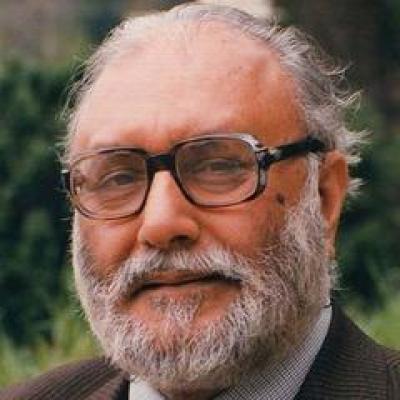
Abdus Salam was a notable Pakistani theoretical physicist and Nobel laureate. The story of Abdus Salam began on 29 January 1926 in Jhang, Punjab Province. The legacy of Abdus Salam continues today, following their passing on 21 November 1996 in Oxford, England.
Mohammad Abdus Salam was a Pakistani theoretical physicist and Nobel laureate . He shared the 1979 Nobel Prize in Physics with Steven Weinberg and Sheldon Glashow "for their contributions to the theory of the unified weak and electromagnetic interaction between elementary particles, including, inter alia, the prediction of the weak neutral current ". He was the first Pakistani, first Muslim scientist, and second person from any Muslim country (after Anwar Sadat of Egypt ) to win a Nobel Prize .
Legacy and Personal Influence
Personally, Abdus Salam was married to Amtul Hafeez Begum, Louise Johnson. Historically, their work is best remembered for Electroweak theory.
Major Contributions
- Electroweak theory
- Goldstone boson
- Grand Unified Theory
- Higgs mechanism
- Magnetic photon
- Neutral current
- Pati–Salam model
- Quantum mechanics
- Pakistan atomic research program
- Pakistan space program
Philosophical Views and Reflections
In 2008, Indian scholar Ravi Singh noted in his book The Military Factor in Pakistan that, "in 1978, Abdus Salam with PAEC officials, paid a secret visit to China, and was instrumental in initiating industrial nuclear cooperation between the two countries." Although he had left the country, Salam did not hesitate to advise the PAEC and Theoretical and Mathematical Physics Group on important scientific matters, and kept his close association with TPG and PAEC.
The Abdus Salam Award (also called the Salam Prize) is an award established to recognise high achievements and contributions in physical and natural sciences. In 1979, Riazuddin, Fayyazuddin and Asghar Qadir met with Salam, and presented the idea of creating an award to appreciate scientists, resident in Pakistan, in their respective fields. Salam donated the money he had won as he felt that he had no right use for the prize money. It was endowed by Asghar Qadir, Riazuddin and Fayyazuddin in 1980, and it was first awarded in 1981. The winners are selected by a committee (consisted of Aghar Qadir, Fayyazuddin, Riazuddin, and others) of the Center for Advanced Mathematics and Physics (CAMP), which administers the award. The Abdus Salam Medal is presented by the Third World Academy of Sciences in Trieste , Italy. First given in 1995, the award is presented to the people who have served the cause of science in the Developing World. The Abdus Salam Shield of Honor in Mathematics was initiated by the National Mathematical Society of Pakistan to promote and recognize quality research in Mathematics in 2015. It was awarded for the first time in 2016.